.webp)
THERFP acronym is one of the most frequently encountered terms in B2B sales, procurement, and public tendering, but its exact meaning and relationship to associated terms like RFI and RFQ remain unclear for many professionals. RFP stands for request for proposal, or in French “request for proposal”, a formal document used by buyers to solicit detailed proposals from qualified suppliers. At Tenderbolt, our AI-powered SaaS platform helps tender managers, pre-sales teams, and procurement professionals to respond to RFPs more quickly and with greater consistency, reducing average response time by up to 70%. This guide covers the full meaning ofRFP acronym, explains how it differs from RFI (Request for Information) and RFQ (Request for Quotation), and describes the RFP process from solicitation to vendor selection.
Understanding the acronym RFP: definition and meaning
THERFP acronym stands for request for proposal. An RFP is a formal document issued by a purchaser, whether a public authority, business, or non-profit organization, to solicit detailed proposals from potential suppliers who are able to deliver a specific product or service. Unlike an informal order form or brief, a request for proposal describes the specific requirements of the buyer, the scope of the project, evaluation criteria, and contractual terms, and invites qualified bidders to submit a proposal explaining how they intend to carry out the project.
THERFP acronym is used in many sectors:
- Public procurement and government tenders : where the issuance of the RFP is subject to strict legal frameworks and mandatory publication rules
- Selection of IT and software providers : where RFPs make it possible to assess the technical approach, integration capabilities and long-term suitability of the supplier
- Professional services : consulting, legal, financial and marketing all use RFP as a standard form of solicitation
- Construction and infrastructure : where RFPs allow project owners to gather detailed offers and assess the resources and expertise of candidates
- Private sector : where RFPs offer buyers the flexibility to structure their tenders according to their own criteria and schedules
Note that RFP refers to a request for proposal in public and private contexts, although the formal rules governing each process differ significantly. In public procurement, the process is regulated by law. In the private sector, RFPs allow buyers to define their own evaluation criteria and deadlines.
What does the acronym RFP cover: the content of a request for proposal
Beyond theRFP acronym itself, what is operationally important is to understand what a complete request for proposal document contains. A well-structured RFP is a formal document designed to give potential suppliers a clear and comparable view of what is expected, how proposals will be evaluated, and what the commitment requires in terms of resources and expertise.
A standard request for proposal generally includes the following sections:
- Organization context : who issues the RFP, the goals of the organization and the problem it seeks to solve
- Project scope and deliverables : a precise description of what must be done, by whom and in what timeframe
- Specific requirements : technical, functional, regulatory or operational specifications that suppliers must address in their proposal
- Assessment criteria : the methodology and weighting used when evaluating proposals, so that bidders know what matters most
- General conditions : contractual conditions, payment structure, confidentiality obligations and legal requirements
- Deadline and delivery format : the date by which suppliers must submit their proposals and the prescribed structure for doing so
- Budget envelope (optional): some buyers indicate a budget range to help potential suppliers calibrate their proposals
Indeed, RFPs are used for complex projects where the needs are well defined but where the solution is not yet determined. This is precisely where the request for proposal structurally differs from RFIs and RFQs, which respond to different stages of the purchasing process.
What is an RFI (request for information) and when should one be issued?
With the RFP defined, it is useful to understand the documents that generally precede it in the procurement process. An RFI, which stands for request for information, is a preliminary document issued by a buyer to gather information about the market, available solutions, or potential suppliers before engaging in a formal purchasing process.
The main objective of an RFI is exploration, not solicitation. Organizations issue an RFI when they:
- Need to understand the capabilities of suppliers : before setting detailed requirements, buyers use RFI to map what the market can actually deliver
- Wish to explore the technologies or approaches available without launching a formal tender
- Make up a shortlist of suppliers : RFIs help to qualify potential suppliers for a future RFP or RFQ
- Lack of sufficient market knowledge : to write a well-structured request for proposal, buyers sometimes have to first gather information via an RFI
Note that RFIs are not binding. Suppliers respond with general information about their business, capabilities, and approach, with no obligation to bid later. An RFI therefore functions as a discovery phase, used to gather information before the launch of a formal purchasing process. In concrete terms, buyers who skip the RFI stage and go directly to the RFP often produce poorly structured documents that generate weak or incomparable proposals.

What is an RFQ (Request for Quotation) and how does it differ from an RFP?
The acronym RFQ stands for request for quotation. Where a request for proposal asks for comprehensive proposals covering approach, methodology, qualifications, and price, an RFQ focuses primarily on price. An RFQ is used when the buyer knows exactly what specific product or service they want to acquire and wants qualified suppliers to submit a quote to deliver it.
RFQs are the appropriate solicitation format when:
- The requirements are well defined : the product or service is standardized and the specifications are set in advance
- Price is the main evaluation criterion : the buyer does not need to assess the methodology or the suitability, only the cost and the terms of delivery
- The perimeter is limited : common goods, standard software licenses, routine maintenance services and similar categories are suitable for the RFQ format
- Speed is a priority : RFQs generate faster responses than full RFPs because suppliers only need to submit a quote rather than detailed proposals
Therefore, the distinction between RFP and RFQ is fundamentally a question of buyer maturity and depth of assessment. Use an RFP when you need to assess how potential suppliers are going to approach a problem. Use an RFQ when the solution is already defined and you need to source it at the best price. Additionally, note that RFQ can also refer to a request for qualifications in certain sectors, including public works and infrastructures, where the qualification of bidders is a legal prerequisite before receiving a complete RFP.
Differences between RFI, RFP, and RFQ: when to use each
Since each document is defined, the practical question is to know which solicitation to issue at which stage. The differences between RFI, RFP, and RFQ are not only definitional: they reflect different levels of buyer maturity, different procurement goals, and different expectations from suppliers.
Concretely:
- Use an RFI when you want to gather information and are not yet ready to launch a formal solicitation. RFIs are non-binding and exploratory.
- Use an RFP when your requirements are sufficiently defined and you need detailed proposals to assess the suitability, approach, and overall value of suppliers. RFPs are used for complex and strategic purchasing decisions.
- Use an RFQ when specifications are set and price is the main decision criterion. RFQs are effective for standardized goods or services.
In other words, the three documents represent a natural progression in purchasing maturity: the RFI collects information, the RFP requests detailed proposals, and the RFQ collects prices for a defined perimeter. Many purchasing cycles use all three in sequence, especially in the public sector where each stage is formally supervised.
How the RFP process works: from soliciting to selecting the supplier
The RFP process follows a structured sequence designed to ensure competition, fairness, and full traceability of purchasing decisions. Understanding how the process starts and takes place is critical for both the buyers who issue the RFP and the suppliers who prepare a response.
The main steps in the RFP process are as follows:
- Preparation : the buyer defines the scope of the project, the evaluation criteria, the deliverables and the contractual conditions, then writes the formal document
- Broadcast : the buyer distributes the RFP to a selected list of potential suppliers, or publishes it publicly on a purchasing portal
- Question and answer period : bidders submit clarifying questions; the buyer provides written answers to all suppliers simultaneously to ensure fairness
- Submission of proposals : suppliers submit their proposals before the set deadline. Late proposals are generally disqualified in most formal processes.
- Evaluation of proposals : the buyer notes and classifies the proposals according to the predefined criteria. A scoring grid is generally used to assess supplier proposals consistently.
- Best final offer (optional): pre-selected bidders may be invited to submit a revised proposal prior to the final award decision
- Supplier selection and contract award : the buyer chooses the best proposal and enters into contractual negotiations with the successful bidder
Therefore, the RFP process is not simply an exchange of documents. It is a formal process designed to streamline competitive tendering, enable structured purchasing decisions, and ensure that all potential suppliers are evaluated on comparable bases.
How AI tools are transforming RFP response management
For suppliers and tender managers, responding to RFPs is notoriously time-consuming. A single response to an RFP typically requires between 40 and 80 hours of coordinated work involving solution architects, legal teams, business experts, and pre-sales salespeople. Scaling this effort across multiple simultaneous RFPs without sacrificing quality is one of the most persistent operational challenges in B2B selling.
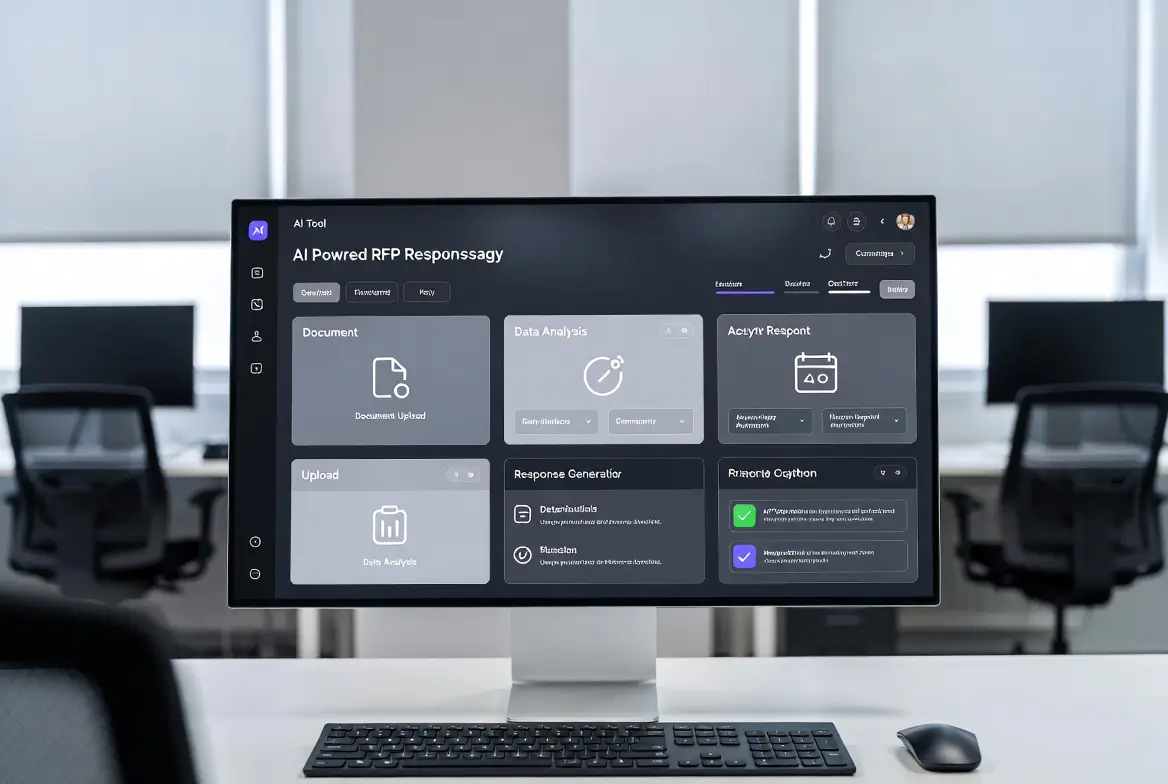
That is precisely the problem that Tenderbolt was designed to solve. Our AI platform automates the most repetitive and time-consuming tasks in the RFP response process:
- Automated document analysis : Tenderbolt reads the RFP and maps every requirement, question, and deliverable in a structured workspace
- Intelligent response generation : the platform relies on your organization's past responses, your library of validated content, and your knowledge base to write answers to each requirement
- Collaborative review environment : contributors review, edit, and validate sections in a single workspace rather than through disconnected email threads and shared directories
- Brand consistency and compliance : Tenderbolt applies your company's approved terminology, style, and positioning to all proposals, regardless of who authored each section
In concrete terms, teams using Tenderbolt reduce their average RFP response time by up to 70% while maintaining the quality of proposals. The measurable results include a higher volume of qualified offers submitted per quarter, better consistency across RFPs, and an improvement in the success rate through better structured and more compelling proposals.
Whether you are responding to a public tender, a private RFP or a supplier questionnaire, Tenderbolt adapts to your purchasing context. Contact our team on https://www.tenderbolt.ai/contact to request a demo and see how the platform is transforming your RFP response process.
FAQS
What does the acronym RFP stand for?
THERFP acronym means request for proposal, translated into French as “request for proposal.” An RFP is a formal document issued by a purchaser, public or private, to solicit detailed proposals from qualified suppliers who are able to deliver a specific product or service. The request for proposal describes the scope of the project, evaluation criteria, delivery requirements, and contractual conditions, and invites potential suppliers to submit their approach, qualifications, and pricing. RFP is the standard solicitation format used in competitive procurement processes in sectors including IT, consulting, construction, marketing, and public procurement. It is different from RFI (request for information) and RFQ (request for quotation), which serve different purposes at different stages of the procurement process.
What is the difference between an RFP and an RFQ?
An RFP invites comprehensive proposals covering approach, methodology, qualifications, and price. An RFQ focuses exclusively on the price for a well-defined product or service. The key distinction is buyer maturity: issue an RFP when you need to assess multiple dimensions of supplier capacity and suitability; issue an RFQ when specifications are set and you simply need a competitive price. RFQs generate faster responses because suppliers only need to submit a quote rather than detailed proposals. RFPs are suitable for complex or strategic purchasing decisions where approach, experience, and methodology matter as much as cost. Choosing the wrong format leads to incomparable offers and slower buying decisions.
When should you use an RFP instead of an RFI?
Issue an RFI when you want to gather information about the market or potential suppliers before engaging in a formal purchasing process. Issue an RFP when your requirements are sufficiently defined and you are ready to seek detailed proposals from qualified suppliers. In practice, many buying cycles start with an RFI to identify and prequalify potential suppliers, then progress to a comprehensive RFP once the buyer has enough information to write a well-structured solicitation. An RFI is non-binding and exploratory; an RFP involves formal obligations and leads directly to supplier selection and contract award. Skipping the RFI stage often leads to poorly defined RFPs that generate weak or incomparable proposals.
What should a response to an RFP contain?
A response to an RFP should address each section of the RFP document directly: company presentation and qualifications, technical approach and methodology, composition of the project team and resources and expertise, prices and commercial conditions, commercial prices and conditions, references and past performances, as well as any additional information specifically requested by the buyer. The response must strictly follow the prescribed format and instructions for submitting the RFP. Proposals that deviate from the required structure are at risk of being disqualified during the evaluation process. Beyond compliance, the most competitive responses clearly articulate the bidder's unique value proposition and demonstrate a thorough understanding of the specific requirements and challenges of the buyer.
How long does the RFP process typically take?
The length of the RFP process varies depending on the complexity of the project, the regulatory context, and the internal governance of the purchaser. A standard RFP cycle in the private sector lasts between 4 and 12 weeks, from issuance to supplier selection. Public procurement RFPs often take longer due to mandatory publication deadlines, formal assessment procedures, and redress rights that may be required by applicable law. For suppliers, preparing a response to an RFP generally requires 1 to 4 weeks depending on the complexity of the requirements. AI-powered tools like Tenderbolt significantly reduce supplier response time by automating document analysis and content generation, allowing teams to submit proposals more quickly without reducing quality.
Is the acronym RFP the same across all sectors?
Yes, theRFP acronym systematically refers to a request for proposal in virtually all sectors and geographical areas. However, the formal rules, document structures, and evaluation criteria governing RFPs vary considerably by sector and jurisdiction. Public procurement RFPs in the European Union follow strict legal frameworks, including European directives on public procurement. In the United States, federal RFPs are governed by the Federal Acquisition Regulation (FAR). In the private sector, buyers have much greater flexibility to customize the RFP process according to their internal procurement policies. The fundamental meaning ofRFP acronym remains constant regardless of the context: a formal request for detailed proposals from qualified suppliers capable of meeting specific purchasing needs.