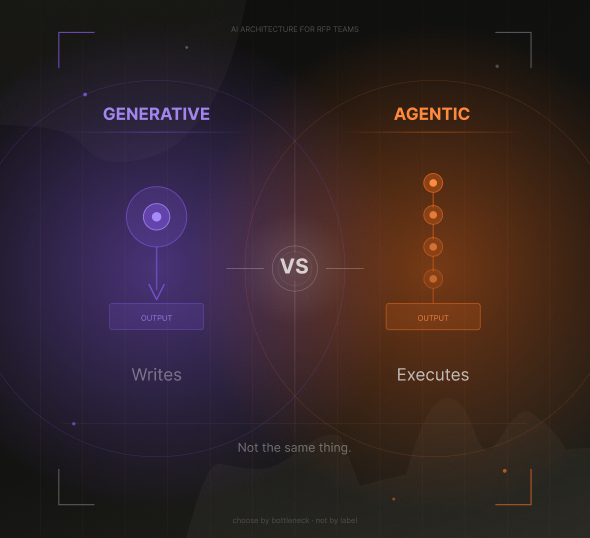
What is the difference between agentic AI and generative AI?
Generative AI creates content in response to prompts: writes text, summarises documents, answers questions. One input, one output, human direction throughout.
Agentic AI goes further. It pursues goals, makes decisions, and executes multi-step tasks with minimal human direction. It receives a goal, "respond to this RFP", and autonomously plans the steps, executes them in sequence, and surfaces only the decisions that genuinely need human judgement.
Agentic AI vs generative AI — at a glance
|
Generative AI |
Agentic AI |
| What it does |
Creates content in response to prompts |
Plans and executes multi-step workflows toward a goal |
| How it works |
Prompt → output, one step at a time |
Perceive → plan → act → verify, autonomously |
| Human involvement |
Required at every step |
Required at defined checkpoints |
| Best for |
Writing speed, first drafts, consistency |
Coordination overhead, high-volume operations |
| In RFP context |
"Write a response to question 7 using our methodology library" |
"Read this tender, extract all requirements, draft all sections, flag gaps, route for review" |
TL;DR — key takeaways
- Generative AI writes text in response to prompts, one step at a time.
- Agentic AI executes multi-step workflows autonomously.
- Agentic AI builds on top of generative AI. Most agentic systems use a generative model as their reasoning engine.
- For RFP teams: generative AI speeds up writing; agentic AI speeds up the entire response process.
- Most teams in 2026 benefit most from high-quality generative AI grounded in their knowledge base.
- The right question is not "agentic or generative?" but "where does my team lose the most time?"
Generative AI in RFP response: what it does well
- First-draft generation: 60–80% of the way to submittable, from your knowledge base.
- Content consistency: consistent language and positioning across contributors.
- Standard section drafting: executive summaries, methodology, company overview.
- Summarisation: a 200-page DCE extracted in minutes.
RAG, why grounding matters. Retrieval-Augmented Generation (RAG) retrieves from your organisation's own knowledge base rather than generic training data. This is what separates a trustworthy RFP AI, drawing from your actual certifications, past projects, and approved methodology, from one that produces plausible but unverifiable content. Every RAG-grounded response is traceable to a source document.
The limitation: generative AI requires human direction at every step. It accelerates individual tasks. It doesn't manage the workflow.
Agentic AI in RFP response: what it adds
Agentic AI extends generative AI with the ability to plan and execute multi-step workflows without continuous human input:
- Receive the tender document.
- Decompose it into requirements, questions, criteria, and deadlines.
- Match requirements against the knowledge base.
- Generate draft responses.
- Flag gaps.
- Route sections to subject matter experts.
- Assemble a complete draft.
- Run a consistency check.
- Present the draft for human review.
Steps 1 to 8 are autonomous. Human judgement comes in at step 9 and at any flagged point along the way.
What agentic AI does not change:
- The quality of your knowledge base.
- The need for human review before submission.
- Your win rate strategy: bid/no-go, win themes, differentiating against this specific buyer.
The practical question for your RFP team
Is your bottleneck writing speed? High-quality generative AI grounded in your knowledge base. First drafts 70% done. Human work shifts from writing to reviewing. RFP automation software like Tenderbolt's AI proposal generator lives here.
Is your bottleneck coordination? High volume, many simultaneous bids, SME chasing, section assembly. Agentic capabilities reduce management overhead.
Is your bottleneck knowledge? No structured repository of approved answers, certifications, references. Neither generative nor agentic fixes this. Fix the knowledge base first.
Most teams in 2026: the bottleneck is writing speed. High-quality RAG-grounded generative AI addresses it directly.
A note on vendor claims
In 2026 virtually every RFP vendor claims "agentic." Look past the label:
- What does it do without a human prompt? Nothing = generative AI with an agentic label.
- What decisions does it make autonomously, and what does it escalate?
- Where is the human oversight? If a vendor claims no human review is needed, that's a risk signal, not a feature.
- What happens when it's wrong? Agentic errors propagate further. Understand the failure modes before trusting live submissions to it.
Where Tenderbolt sits
Our philosophy is deliberate: maximum accuracy, with human judgement at the right moments.
- Automated analysis: extracts every requirement, criterion, weighting, and deadline without human direction.
- RAG-grounded first drafts: from your actual knowledge base, not generic training data, not invented.
- Explicit gap flagging: can't find a confident answer? Says so. Doesn't fill gaps with fabrications.
- Human review before submission: nothing leaves without team approval.
This is a hybrid approach: automated analysis, RAG-grounded generation, deliberate human checkpoints. Not fully agentic. Not purely generative. Designed for real RFP teams: serious deadlines, limited resources, zero tolerance for inaccuracy.
Book a demo
Tenderbolt analyses tender documents, generates first drafts from your knowledge base, and gives your team 70% of their time back. Visit /contact to see it run on your own RFPs.