
Public Procurement Thresholds 2026: Amounts, Procedures & Key Rules
The 2026 public procurement thresholds: EU figures, MAPA, formalized procedures, and what each amount means in practice. Clear reference for buyers and suppliers.
The 2026 public procurement thresholds: EU figures, MAPA, formalized procedures, and what each amount means in practice. Clear reference for buyers and suppliers.
Public procurement thresholds are key amounts that determine the legal regime applicable to each acquisition. They vary according to the type of contract, the type of public purchaser and the nature of the service. Crossing a threshold radically changes the rules of the game: mandatory advertising, publication deadlines, formalized or adapted procedure. At Tenderbolt, we help public governance teams decipher these rules and optimize their procurement processes.
Mastering the reference amounts is essential for three reasons:
This article offers you a complete guide to regulatory ceilings in 2026, with amounts excluding VAT, applicable regimes and concrete use cases.
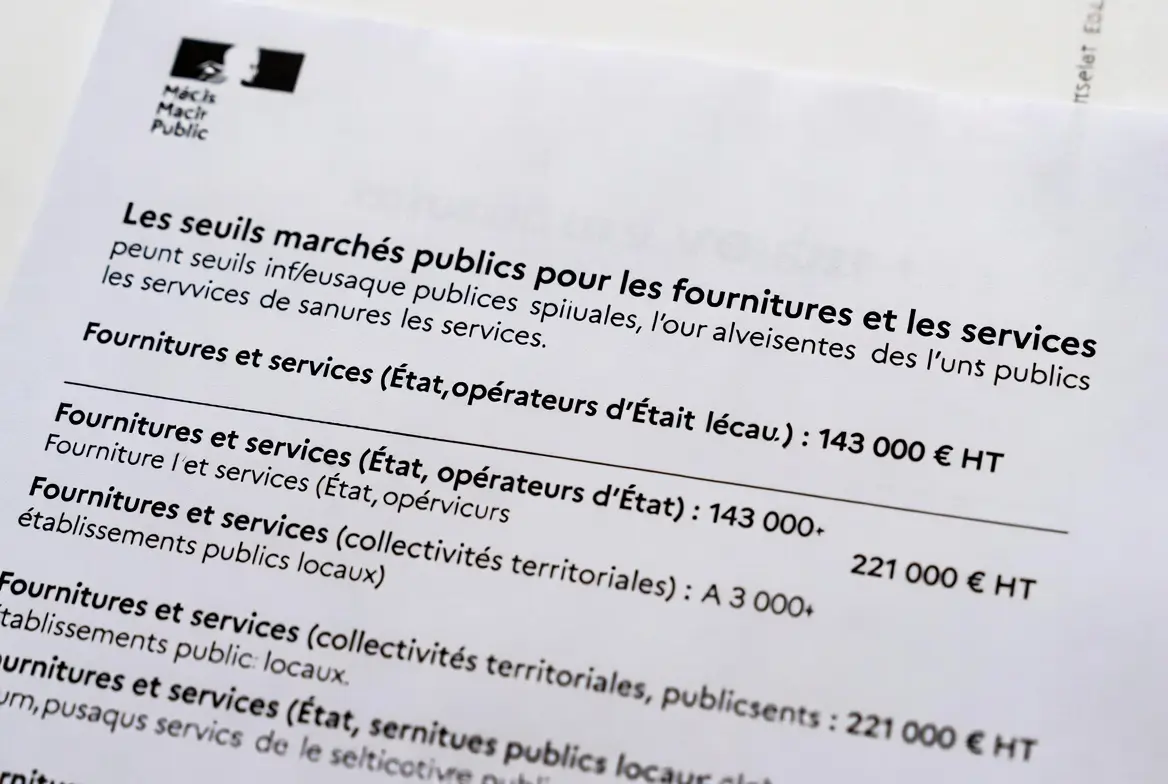
For the purchase of supplies and services, the public procurement code distinguishes between two categories of purchasers: the State and its operators on the one hand, and local authorities and their groups on the other. This distinction has a direct impact on limit values applicable.
As of 1 January 2024, the European Commission revised the notification thresholds. These new amounts apply for the period 2024-2025 and serve as a reference until the next revision.
In 2026, these amounts remain in force in the absence of a new European revision. Public purchasers must check the estimated amount excluding VAT of their contract (all costs included except VAT) to determine the applicable threshold. Tenderbolt supports its customers in this critical calculation, which avoids non-conformities and accelerates the approval of contracts.
Work contracts are subject to distinct threshold values. The European threshold for works is significantly higher than for supplies and services, which explains why the majority of local public construction sites fall under the adapted procedure.
This threshold of work is mandatory for all buyers, regardless of their status. The renovation of a town hall, the construction of a road or the rehabilitation of a school group must be classified according to this amount. Tender managers must add up all project items (construction, engineering, control) to calculate the exact estimated amount excluding tax, which determines the procedure.
To cross or not to cross these reference amounts Change everything. Above, it is the formalized procedure; below, it is the adapted procedure. This distinction is not trivial.
Formalized procedure (threshold exceeded):
Adapted procedure (below the threshold):
Our experience at Tenderbolt shows that public purchasers who ignore these ceilings expose their decisions to appeals and cancellations. A simple ranking error can invalidate a 1 million euro contract.
To quickly visualize these limit values and associated procedures, this summary table centralizes critical information:
| Contract type | Buyer | Threshold (excl. VAT) 2026 | Procedure below threshold | Minimum publication |
|---|---|---|---|---|
| Supplies & services | State | €143,000 | Adapted (MAPA) | BOAMP (recommended) |
| Supplies & services | Local authorities | €221,000 | Adapted (MAPA) | BOAMP (recommended) |
| Works | State & local authorities | €5,538,000 | Adapted (MAPA) | BOAMP (recommended) |
This table summarizes the main threshold values for 2026. Note that for works, the threshold is significantly higher (5.5 million) than for supplies (143 k to 221 k), which explains the preponderance of adapted procedure at local construction sites.
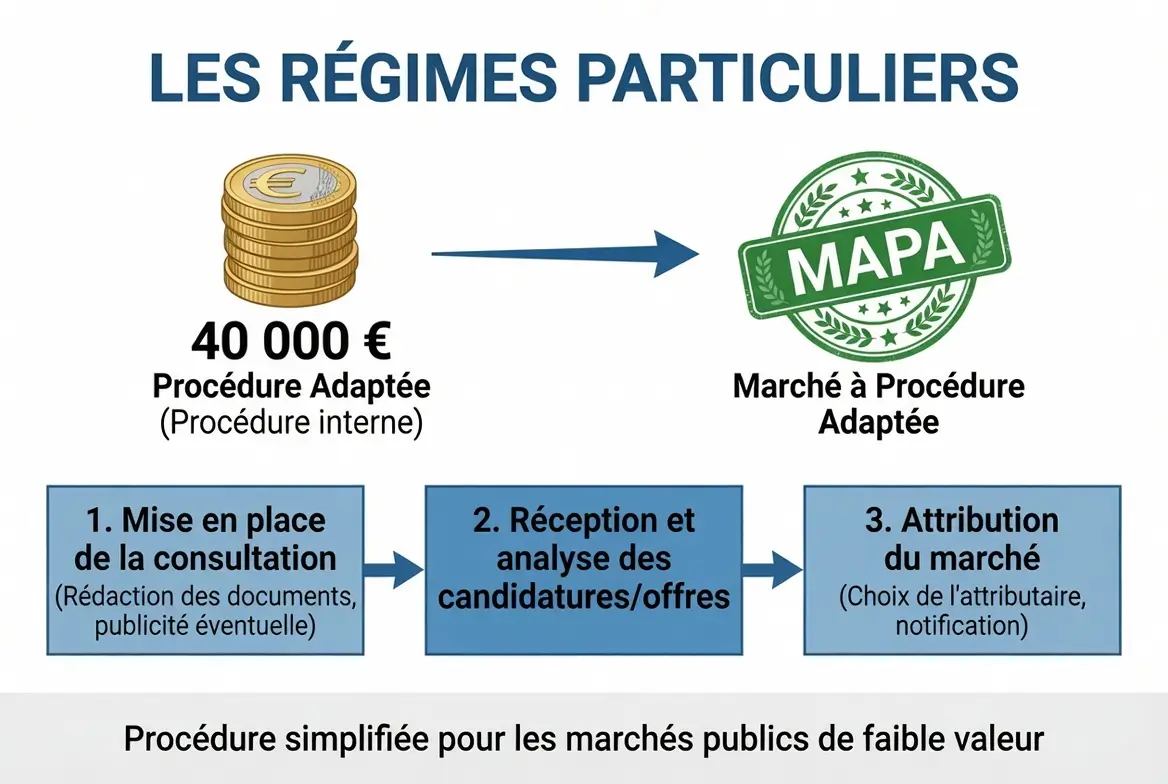
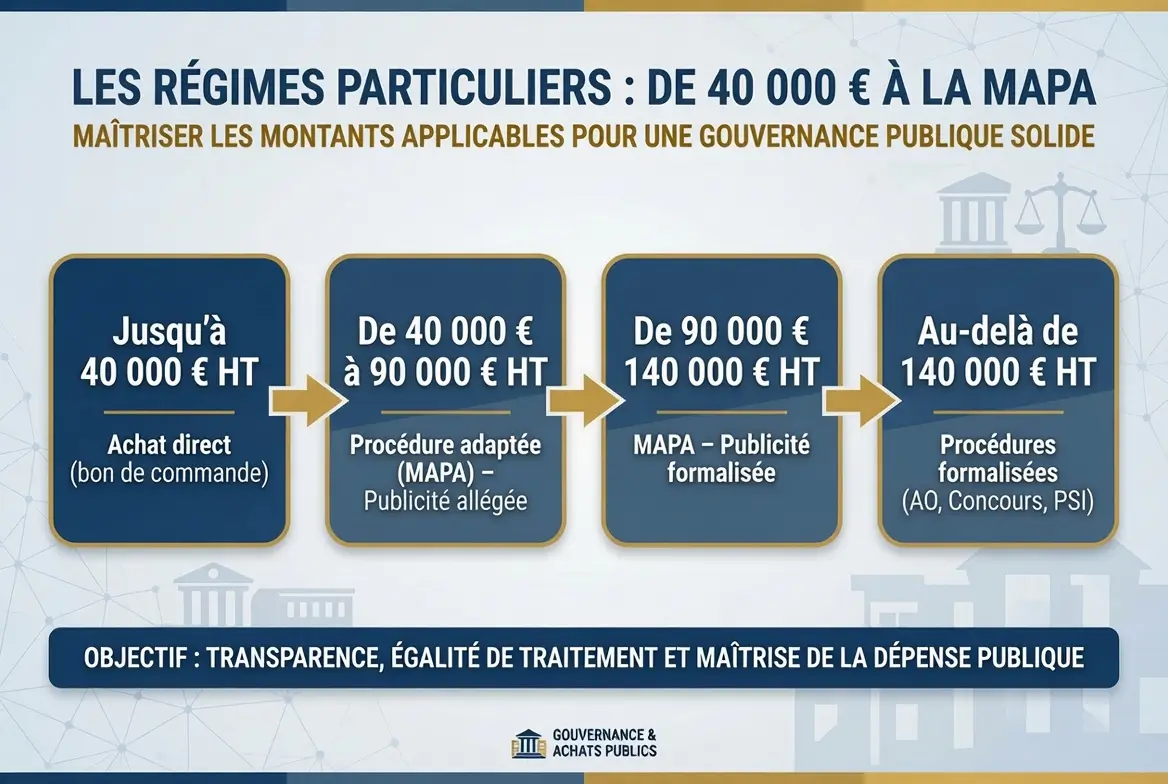
Between the zero threshold and the regulatory ceilings In general, there are gray areas and intermediate regimes that buyers often forget about.
Without competitive tendering or advertising (under €40,000 excluding VAT):
MAPA (Adapted Procedure Markets):
In practice, MAPA is the preferred regime for local authorities for medium-sized markets. Tenderbolt helps its users to identify the right regime and to structure the tender accordingly, without publishing unnecessarily in the OJEU and maintaining flexibility and efficiency.
The publication of tenders depends directly on the thresholds crossed. Two distinct channels exist:
BOAMP (Official Bulletin of Public Procurement Announcements):
OJEU (Official Journal of the European Union):
Our Tenderbolt customers report that the confusion between BOAMP and OJEU is creating costly mistakes. Publishing to the BOAMP for a market that exceeds the threshold does not cancel the OJEU obligation; conversely, publishing to the OJEU for a market under the threshold is useless but without malice.
The crossing of these critical amounts also determines the type of tender possible.
Above the thresholds (formalized procedure):
Below the thresholds (adapted procedure):
This flexibility explains why limit values Shortages attract local authorities: less bureaucracy, but minimal respect for competition. Tenderbolt guides its customers to structure an appropriate procedure without falling into arbitrariness.
Public procurement thresholds in 2026 remain the regulatory tipping points that determine everything from publication obligations to appeal deadlines. Confusing €143,000 and €221,000 can expose a contract to challenge; missing the €5.5 million works threshold can paralyse a construction project. Getting the classification right before launching the tender is non-negotiable.
Tenderbolt was built to help bid teams navigate this complexity. It automatically flags the applicable threshold for each contract, guides the choice of procedure, and structures the tender file so nothing is missed. Less time on compliance checks, more time on the response that wins.
See how Tenderbolt works for public tenders
For a local authority (municipality, department, region), the threshold for supplies and services is €221,000 excluding VAT. Beyond that, you must publish in the OJEU and respect a formalized procedure. Otherwise, the appropriate procedure applies, with BOAMP publication recommended. For works, the threshold is €5,538,000 excluding VAT, the same for all public purchasers. These amounts have been in force since January 1, 2024 and remain in force in 2026.
The distinction reflects the fiscal context and regulatory philosophy. The State and its operators are subject to a lower threshold (€143,000 excluding VAT) because they manage massive budgets and must demonstrate exemplary transparency. Local authorities, with smaller budgets, benefit from a more permissive threshold (221,000€ excluding VAT). This difference prevents small municipalities from being overwhelmed by the same requirements as ministries. At Tenderbolt, we advise our customers to check their buyer status before applying a threshold.
Add up all the direct costs of the service: supplies, services, labor, ancillary costs. Exclude VAT. If your market includes several lots or phases, aggregate them together. If it is a multi-year contract, add up the total value over time (for example, a 3-year contract at €80k/year = €240k compared to the threshold). Optional renewals also add up. This rigor of calculation is essential: we have seen communities circumvent the OJEU by artificially dividing a 600k € market into six 100 k € markets; this is illegal and exposed to recourse.
The BOAMP publication is not mandatory for markets under European thresholds, but it is strongly recommended. Publishing to BOAMP demonstrates your transparency, protects your decision in case of appeal, and broadens the pool of candidates. For a MAPA market (between €40k and the threshold), the BOAMP publication becomes a best practice. For very small purchases (less than €40k), you can do without it, but a few comparative quotes are enough to prove diligence. At Tenderbolt, we push all our customers toward minimal BOAMP publishing: the cost is zero and the value is huge.
It is a serious non-compliance. An excluded candidate may challenge, the court of auditors may review the contract, and the administrative judgment will likely cancel the contract. You will have to relaunch the tender in accordance with, delay or cancel the service. This error costs months and thousands of euros in litigation. Tenderbolt reminds all its users: check the threshold BEFORE launching the tender, not after. It is one of the biggest sources of error in communities.
Yes. The European Commission reviews the thresholds approximately every two years, in January (even years). The new thresholds applicable in 2026 date back to January 2024: €143,000 (State), €221,000 (local authorities), €5.5 million (works). In January 2026, new amounts could be announced. We recommend regularly checking the official source (site dila.gouv.fr, ministerial circulars) to stay up to date. Tenderbolt automatically integrates these reviews into its database so its customers never miss out.
Contact us now