
Artificial intelligence is revolutionizing proposal management. In 2025, AI-driven RFP software offers specialized automation that streamlines the entire lifecycle of RFP responses, from content curation to real-time collaboration.
By integrating seamlessly with platforms like Google Drive and relying on powerful response management tools, these systems enable proposal teams to deliver faster, more accurate, and better responses. They are aimed at sales, bid and proposal teams, offering them a competitive advantage to effectively deal with the complexity of RFPs and compliance questionnaires. Using intelligent agents and automation loops, the software reliably manages frequently asked questions and fills in CLSs, allowing teams to build answers that highlight their expertise and increase their win rates. Additionally, many organizations are now adopting tender management software to streamline their processes and stay ahead of the curve in a competitive environment.
This ranking reflects the views of Tenderbolt experts, based on a comparative analysis of features, innovation, and impact for users.
The strategic impact of AI-powered RFP platforms
In this rapidly changing landscape, the right RFP automation software doesn't just speed up writing: it also strengthens collaboration between business experts and stakeholders, making teams more agile and more effective. Understanding the capabilities of these tools is essential to improve the quality of proposals, increase precision and drastically reduce response times. Leverage these platforms to simplify manual processes and achieve more results with less effort.
1. Tenderbolt AI: the most advanced native AI RFP software
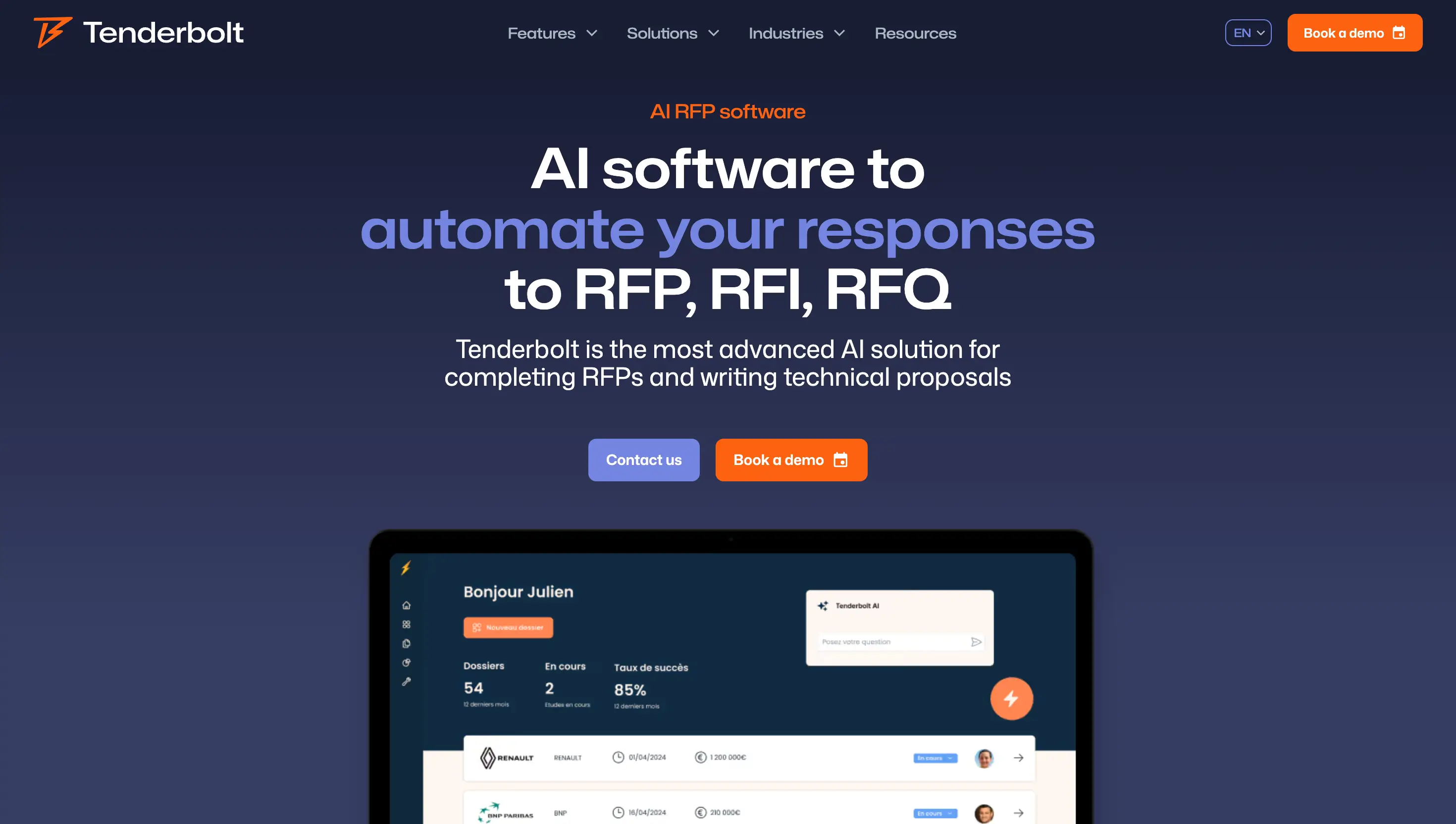
Automating RFP responses with AI
Tenderbolt AI stands out as the most advanced native AI software, designed specifically to automate RFP responses. It intelligently analyzes tender documents, including supplier questionnaires and Excel formats such as IT security or GDPR questionnaires, and automatically generates accurate and adapted answers.
This automation can save up to 70% of the time traditionally spent reading, understanding, and completing proposals manually. By automating this very time-consuming process, Tenderbolt improves both the quality and accuracy of responses, increasing the chances of winning more deals.
Building your AI knowledge base
What sets Tenderbolt apart is its dynamic AI knowledge base, which centralizes reusable content: old proposals, reference documents, internal policies, etc. This database is continuously fed, with the AI suggesting relevant updates so that the content of your proposals remains up to date and optimized.
Tenderbolt integrates easily with essential tools like Google Drive, SharePoint, CRM, and collaboration platforms, maintaining a synchronized and responsive content ecosystem for the entire team. This seamless connection to your data infrastructure makes it possible to quickly exploit reliable and validated information during writing.
Improving team collaboration with AI
Tenderbolt's collaborative interface uses AI to facilitate communication and validation between business experts and writers. Multiple stakeholders can review, edit, and approve content in real time, reducing bottlenecks and ensuring higher quality responses.
By structuring Go/No Go decisions, identifying key risks, and automatically sharing critical insights, this AI platform reinforces team alignment and effectiveness. Writers and experts can react faster and deliver winning answers with more confidence, thanks to intelligent team-centric automation at Tenderbolt.
2. Responsive.io: the RFP AI software for large accounts
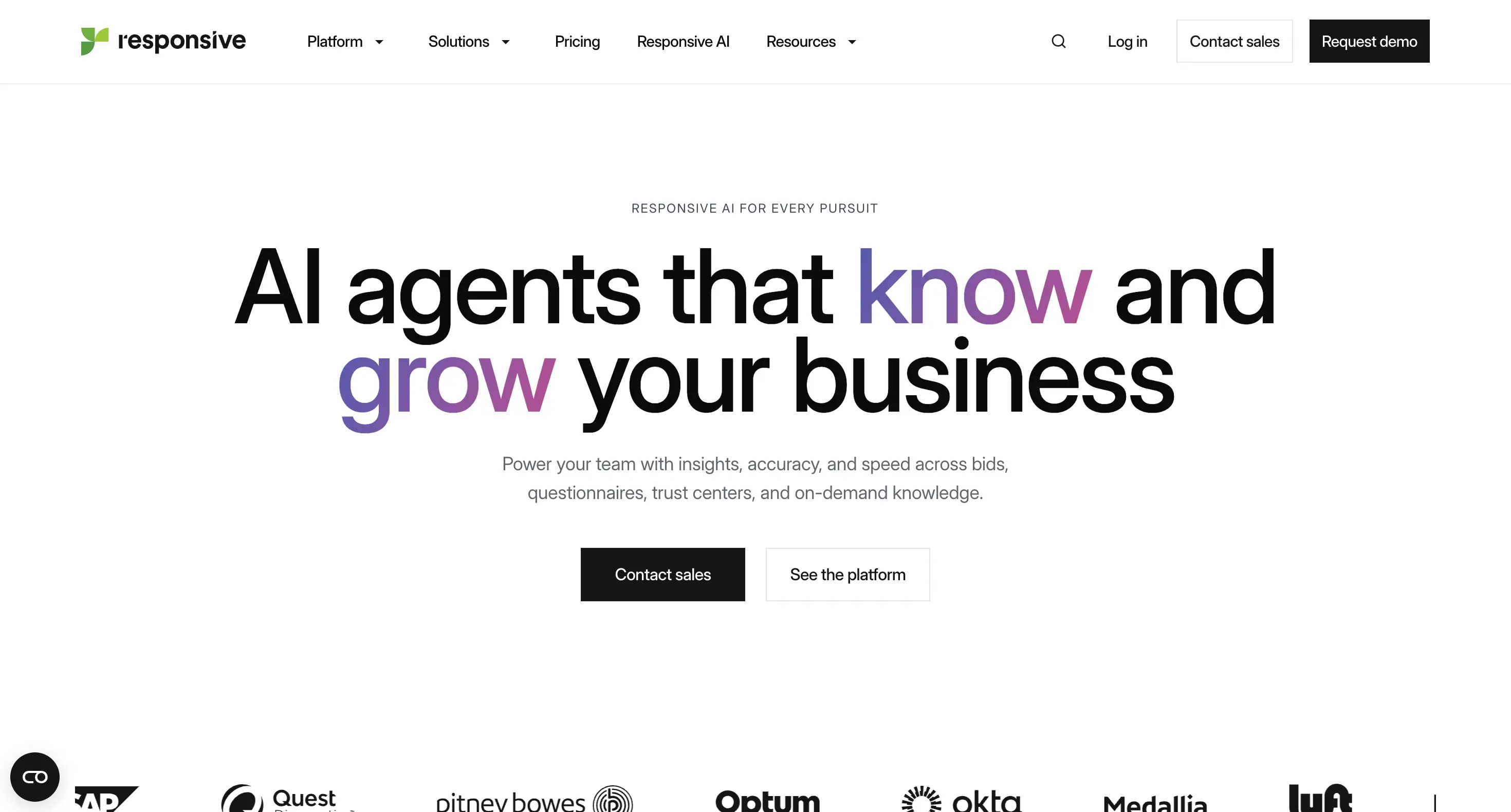
Accelerating complex RFP responses with AI
Responsive.io is designed for key account teams that manage large volumes of RFPs, DDQs, and security questionnaires, offering unparalleled speed, accuracy, and reliability. Thanks to its patented AI agents, Responsive.io analyzes, organizes, and responds to even the most complex documents, filled with tables, dropdown lists, and nested sub-sections, ensuring that no detail is overlooked.
The platform uses advanced AI models to instantly produce first drafts, both for narrative parts and for quizzes. By relying on your library of approved content, it can process technical documents, such as security questionnaires, in just a few seconds, significantly relieving your InfoSec teams. With Responsive.io, teams can achieve up to 80% less response time, giving them more scope for strategic aspects, improving quality and, ultimately, winning new contracts. Its integration of RFP response software also guarantees smoother document management and effective collaboration.
Manage vast content libraries at scale
For organizations with large content repositories, Responsive.io offers a centralized and highly searchable knowledge hub that makes it easy to find and reuse validated responses. Thanks to its AI-powered recommendation engine, the platform automatically suggests relevant answers, flags content to be updated, and ensures consistency across all cases — a key factor in maintaining accurate and competitive responses at scale.
Responsive.io also takes a proactive approach to content management by identifying gaps and offering updates, so your team has accurate, compliant, and compelling materials. This feature not only helps increase win rates, but it also reduces the risk of mistakes that can hurt your competitive position.
Integrate with your existing tech stack
Responsive.io knows that key account workflows rely on integration with numerous content management, collaboration and project management tools. The solution therefore provides robust compatibility with platforms like Google Drive, SharePoint, CRMs, and productivity suites. The content thus remains accessible and synchronized for all teams, regardless of their workplace or their usual tools.
The platform promotes global collaboration, allowing distributed teams to track progress, review drafts, and finalize proposals in real time within a single, intuitive system. The result: a solution that is both responsive and scalable, that integrates perfectly into your current operations while adapting to the growth of your business.
3. RFP360: a complete RFP platform with AI capabilities
Centralize your proposal process with intelligent automation
RFP360 aims to bring your entire proposal process together in one place, with intelligent automation that greatly reduces administrative tasks. Its centralized knowledge base allows your team to easily update, store, and retrieve content, ensuring consistency and accuracy on all proposals.
With all the past answers, case studies, and FAQs instantly searchable, you can start a new RFP with a large stock of approved and relevant content, freeing up time for strategy and reducing the risk of errors. Whether you're responding to a security questionnaire or a big software tender, RFP360's automation tool takes care of repetitive tasks, so your team can focus on winning the deal.
Use AI to recommend the best answers in real time
RFP360's AI features go beyond simple libraries: the platform analyzes each new RFP and automatically suggests the best answers from your database, speeding up response times and ensuring high quality. This intelligent content curation helps your team deliver more accurate and compelling proposals, while improving over time through learning based on your feedback and proposal data.
By providing recommendations in real time, RFP360 acts as a true response management assistant, sharpening your competitive advantage RFP after RFP.
Collaborate between departments without friction
Large cross-functional teams often face proposal chaos — RFP360 eliminates this friction with robust collaboration tools. Numerous stakeholders, from business experts to compliance managers, can easily contribute, monitor progress, and review changes in a single platform. This real-time collaboration avoids bottlenecks and confusion, especially when deadlines are short.
The platform's reporting and analytics features also help your organization understand which responses are performing best and which suppliers are the most responsive, turning proposal data into actionable insights to increase your win rates. With RFP360, your team stays agile, connected, and ready to produce winning answers as soon as the opportunity arises.
4. Loopio: intelligent RFP automation for successful teams
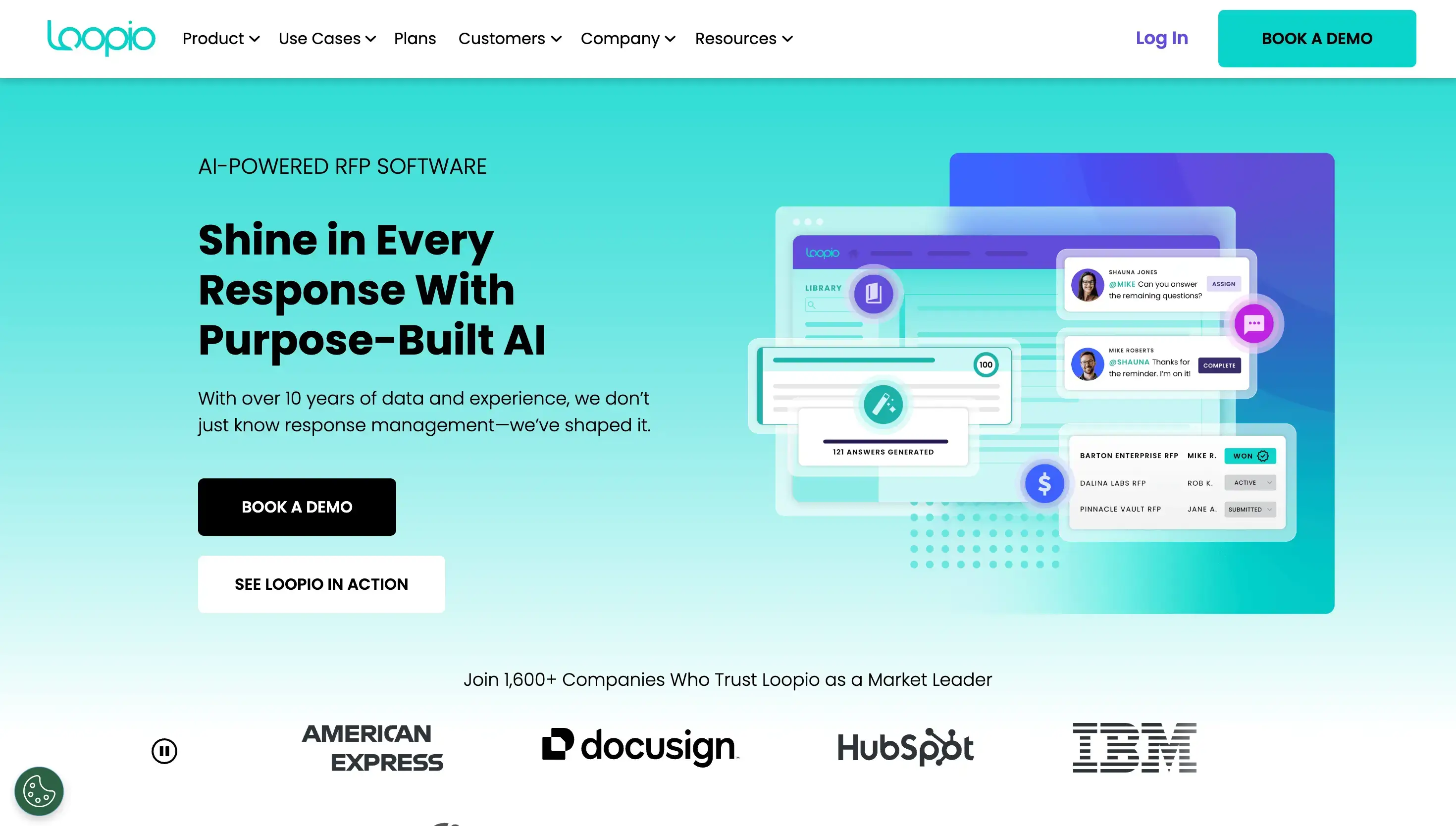
An AI-driven response library to go faster
The AI-powered content library is at the heart of Loopio's automation process. This well-structured repository organizes and stores your most valuable content (past RFP responses, case studies, FAQs) and makes them easy to find and reuse. Thanks to the AI that keeps the library accurate and up to date, Loopio simplifies the search for the right items, allowing for faster answers and greatly reducing search time.
This effective content management accelerates your response workflow while improving the quality of proposals, ensuring consistency and accuracy across all submissions.
Smart suggestions based on past RFPs
Among Loopio's flagship features is its intelligent suggestion tool “Magic”, which uses AI to analyze questions from incoming RFPs and automatically offer relevant answers from your library. Although the experience may vary, this tool offers a real advantage by providing a solid starting point, especially for complex or repetitive questions.
This AI-driven approach ensures that your proposals remain rooted in your organization's proven expertise, strengthening the trust of evaluators and increasing your chances of winning tenders.
Track engagement and performance
Beyond writing quality responses, Loopio provides teams with powerful analytics tools that deliver a clear vision of their RFP processes. From completion rates to response quality and team performance indicators, these detailed metrics provide a solid basis for refining your strategies and optimizing future proposals.
By exploiting these insights, teams can identify areas for improvement, make decisions based on data, and ultimately increase their win rates and business growth.
5. Ombud: AI-driven content curation for proposals
Dynamically generate customized responses
Ombud relies on AI to dynamically generate highly personalized responses, adapted to the unique requirements of each opportunity. Instead of using static models, the platform orchestrates and delivers the right content to the right audience in the most relevant format and context, helping you produce proposals that really speak to evaluators and respond effectively to business challenges.
This dynamic approach allows sales and proposal teams to maintain large-scale customization, increasing the impact of each submission.
AI-driven content scoring for accuracy and relevance
One of Ombud's strengths is its machine learning engine that continuously scores and sorts your content library to ensure accuracy, relevance, and timeliness. As your team uses and updates content, Ombud's system evaluates and flags outdated or lower-quality items to maintain a clean and reliable knowledge base.
This continuous curation prevents outdated or incorrect answers from ending up in your proposals and helps your teams prioritize updates, a key factor in improving quality and success rate.
Ideal for sales teams and pre-sales enABLEMENT
Ombud's content collaboration and proposal automation tools are particularly suited to sales and pre-sales teams who need to respond quickly to a variety of RFPs and security questionnaires, while aligning the discourse between multiple stakeholders.
By streamlining content management and promoting inter-team workflows (permissions, notifications, configurable deadlines), Ombud makes it possible to reduce response times without sacrificing quality, and to gain in performance on complex bidding processes.
It is an excellent choice for organizations that want to increase responsiveness and efficiency in highly dynamic revenue environments.
6. XaitPorter: AI-powered proposal collaboration software

Streamline proposal writing with smart workflows
XaitPorter is transforming the bidding and proposal process by combining automation and intelligent workflows that allow teams to collaborate in real time, without the constraints of traditional linear file systems. With its ability to intelligently import RFP requirements, the platform instantly cuts out tasks and assigns responsibilities to the proposal team, ensuring nothing falls through the cracks.
Building on the powerful recommendations of Xaitai, relevant library content is analyzed and suggested, allowing for stronger and more comprehensive answers to be developed with much less effort, and in record time. Teams often see a reduction in submission times of up to 70%, which results in faster deliveries and greater efficiency.
Ensuring brand consistency and compliance through AI checks
Brand consistency and compliance standards remain critical priorities, especially for large businesses and highly regulated sectors. XaitPorter's AI automation not only improves speed: it also requires uniform formatting, language consistency, and graphic design across all documents thanks to customizable templates and automatic layout.
Each proposal is subject to strict checks against your style guides and compliance criteria, which reduces the risk of errors and optimizes the review cycle. Note: XaitAI is a closed AI system, designed to work exclusively with internal company data, so your information remains secure and under control, without the vulnerabilities associated with public models.
Assign roles and collaborate in real time
XaitPorter strengthens collaboration through a smooth and secure experience — team members can co-write proposals from anywhere. Changes and comments are visible in real time, while progress is managed via an intuitive dashboard. With role-based access rights, it is possible to assign tasks and permissions to contributors, business experts, and validators, ensuring clear accountability for deliverables and deadlines.
Integrated version control and activity tracking keep teams aligned and reduce the risk of misunderstandings, while cloud storage ensures that all distributed teams have access to up-to-date documents at all times. This structured and dynamic environment increases productivity and makes it possible to deliver better quality, fully compliant proposals with more confidence.
Conclusion: RFP AI software
AI-based RFP software is transforming the future of proposal management by automating time-consuming tasks, increasing accuracy, and improving collaboration between teams. Tools like Tenderbolt AI, Responsive.io, and Loopio allow your teams to respond faster with better content, increase win rates, and secure a competitive edge.
By relying on centralized knowledge bases, real-time AI recommendations, and seamless integration with your existing technology stack, the entire response process becomes much smoother. To stay competitive as we approach 2025, adopting these AI-driven solutions is no longer just a plus, it's essential: start exploiting automation now to boost productivity, ensure consistency, and increase the success of your proposals.
FAQ: RFP AI software
1. What is an RFP IA software?
An RFP AI software is a cloud management system that uses artificial intelligence to streamline tendering processes. It helps sales, marketing, and compliance teams automate RFP workflows, manage content, and improve efficiency across the entire proposal lifecycle.
2. How does AI improve the RFP response process?
AI improves your business processes by automatically analyzing RFPs, suggesting relevant content, and learning from past submissions. This easy-to-use management software reduces manual work, speeds up response times, and improves the overall ROI of your proposal activities.
3. Who uses RFP IA software?
They are widely used by sales teams, marketing automation specialists, proposal managers, and compliance managers in businesses dealing with complex or large RFPs. Teams that already work with tools like Salesforce, HubSpot, or other SaaS and project management solutions benefit greatly from RFP AI integrations.
4. What features should you look for in an RFP IA software?
The best RFP AI tools (or “X products”) generally offer:
— AI-powered content suggestions;
— a centralized knowledge base;
— automated workflows;
— integrations with CRMs like Salesforce and HubSpot;
— collaboration in real time;
— secure content governance;
— easy deployment options in your existing management systems.
5. What are the advantages of using an RFP AI software?
Key benefits include:
— shorter RFP response times;
— fewer human errors;
— higher quality of proposal and higher win rates;
— better collaboration;
— an improved ROI;
— better alignment with marketing automation and project management tools;
— more effective management of content, workflows and validation circuits.
6. Is there a free trial for the RFP IA tools?
Yes, many RFP AI software providers offer a free trial period to test automation features, knowledge base implementation, and CRM integrations before committing. It's a great way to assess ergonomics, the fit with your teams, and the potential impact on your business processes.