Top AI RFP Software in 2026: Honest Comparison for Bid Teams
The best AI RFP software in 2026, compared honestly on features, AI quality and fit for bid teams. Find the right tool and win more tenders.
The best AI RFP software in 2026, compared honestly on features, AI quality and fit for bid teams. Find the right tool and win more tenders.
Most AI tools that claim to handle RFPs are general-purpose writing tools with an RFP-shaped wrapper. A small number are genuinely built for the job: reading dense tender documents, mapping requirements against your knowledge base, drafting traceable answers, and managing review and submission under real deadline pressure. This comparison covers the six best in 2026, evaluated from the perspective of a bid team that responds to tenders regularly, not a procurement team that issues them.
In this rapidly evolving landscape, the right RFP automation software not only accelerates proposal writing but also fosters collaboration among subject matter experts and stakeholders, making teams more agile and effective.
Understanding the capabilities of these tools is essential for improving proposal quality, boosting accuracy, and drastically reducing turnaround time. Leverage these platforms to simplify manual processes and drive greater success with less effort.
| Solution | Key features | Best for | AI capability |
|---|---|---|---|
| Tenderbolt | Full document analysis, knowledge-base drafting, Go/No-Go scoring, security questionnaires | Bid teams responding to public tenders, RFPs, and security questionnaires | AI-native, full traceability, no hallucinations |
| Responsive | Patented AI agents, complex RFP handling, enterprise security | Enterprise teams, compliance and security | AI drafting, gap detection, real-time suggestions |
| Arphie | AI knowledge agents, source citations and confidence scores, questionnaire automation | Mid-market teams with high questionnaire volume | AI-native, answer transparency, SOC 2 Type 2 |
| Loopio | Smart answer library, Magic suggestions | Sales teams, mid-to-large organisations | AI content curation, automation workflows |
| Qvidian | Centralised content library, AI Assist, CRM integration | Enterprise and mid-market, content-library-first teams | Generative AI content revision, automated answering |
| XaitPorter | Proposal collaboration, smart templates | Distributed teams, regulated industries | Closed AI system, versioning, brand compliance |
Tenderbolt was built specifically for bid teams, not adapted from a general writing tool. It reads the full RFP or tender document, maps every requirement automatically, and drafts answers from your own validated content and past responses. Every answer links back to the source it came from. When the answer is not in your knowledge base, it tells you rather than inventing one. No Shortcuts. No Hallucinations. No Excuses.
It handles the full range of structured formats bid teams face: public procurement documents (DCE, CCTP/CCAP), private RFPs and RFIs, IT security questionnaires, and Excel-based compliance grids. The Go/No-Go analysis flags which tenders are worth pursuing before the team commits time. Collaborative review and sign-off are built into the workflow.
Teams that use it report up to 70% time saved on response production, x4 velocity, and a 25% increase in success rate. Your experts stay in the driving seat. The software does the repetitive work.
Advantages: Purpose-built for structured tender formats; full answer traceability, no hallucinations; strong fit for French public procurement; handles security questionnaires and Excel grids natively; collaborative workflow with review and sign-off built in. Disadvantages: Specialist tool, less flexible outside the tender and RFP context. Pricing on request.
See how Tenderbolt works for bid teams
Responsive.io is specifically designed for enterprise teams dealing with large volumes of RFPs, DDQs, and security questionnaires offering unrivaled speed, precision, and reliability. Leveraging its patented AI agents, Responsive.io analyzes, organizes, and responds to even the most intricate documents, including those filled with tables, dropdowns, and multi-layered subsections, ensuring that no detail is overlooked.
The platform uses advanced AI models to instantly produce initial drafts for both narrative and questionnaire based responses. By drawing from your trusted content library, it can even process technical documents, such as security questionnaires, in mere seconds providing relief to your InfoSec teams by eliminating repetitive manual tasks. With Responsive.io, teams can achieve up to 80% faster response times, allowing more focus on strategic efforts, quality enhancements, and ultimately, securing more wins. Its integration of rfp response software also ensures smoother document management and efficient collaboration.
For organizations possessing extensive content repositories, Responsive.io offers a centralized and highly searchable knowledge hub that streamlines the retrieval and reuse of approved answers. Thanks to its AI-powered recommendation engine, the platform auto suggests relevant responses, flags content for updates, and ensures consistency throughout all submissions a critical factor in maintaining polished and competitive responses at large-scale operations.
Responsive.io also takes a proactive approach to content management by identifying gaps and proposing updates, ensuring your team has access to accurate, compliant, and compelling materials. This functionality not only helps boost win rates, but also minimizes the risk of errors that could compromise your competitive standing.
Responsive.io recognizes that enterprise workflows depend on integration with multiple tools for content management, collaboration, and project tracking. Therefore, it provides robust compatibility with popular platforms such as Google Drive, SharePoint, CRMs, and productivity suites. This ensures accessibility and synchronization of content across all teams, regardless of their location or preferred tools.
The platform fosters global collaboration, enabling distributed teams to efficiently track progress, review drafts, and complete proposals in real-time all within a single intuitive system. The outcome? A solution that is not only responsive and scalable but also perfectly integrates into your current operations while adapting to your business growth.
Arphie is an AI-native RFP response platform built for teams that need to clear high volumes of questionnaires, security reviews, and structured RFPs quickly. Its defining feature is transparency: every AI-generated answer comes with a source citation and a confidence score, so teams can verify outputs rather than second-guess them. It also surfaces outdated content in your knowledge base and flags duplicates, reducing the manual overhead of keeping libraries current.
Arphie handles imports in Excel and Word, detects questions and sections automatically, and supports role-based permissions, task assignments, deadline tracking, and Slack/Teams notifications. SOC 2 Type 2 compliant, with SAML 2.0 SSO and encrypted data at rest and in transit.
Advantages: Source citations and confidence scores on every answer; fast first drafts for questionnaire-heavy workflows; knowledge base maintenance features; SOC 2 Type 2; easy onboarding. Disadvantages: Designed primarily for structured Q&A and questionnaire-type RFPs; less suited to long-form, narrative proposal writing. Pricing on request.
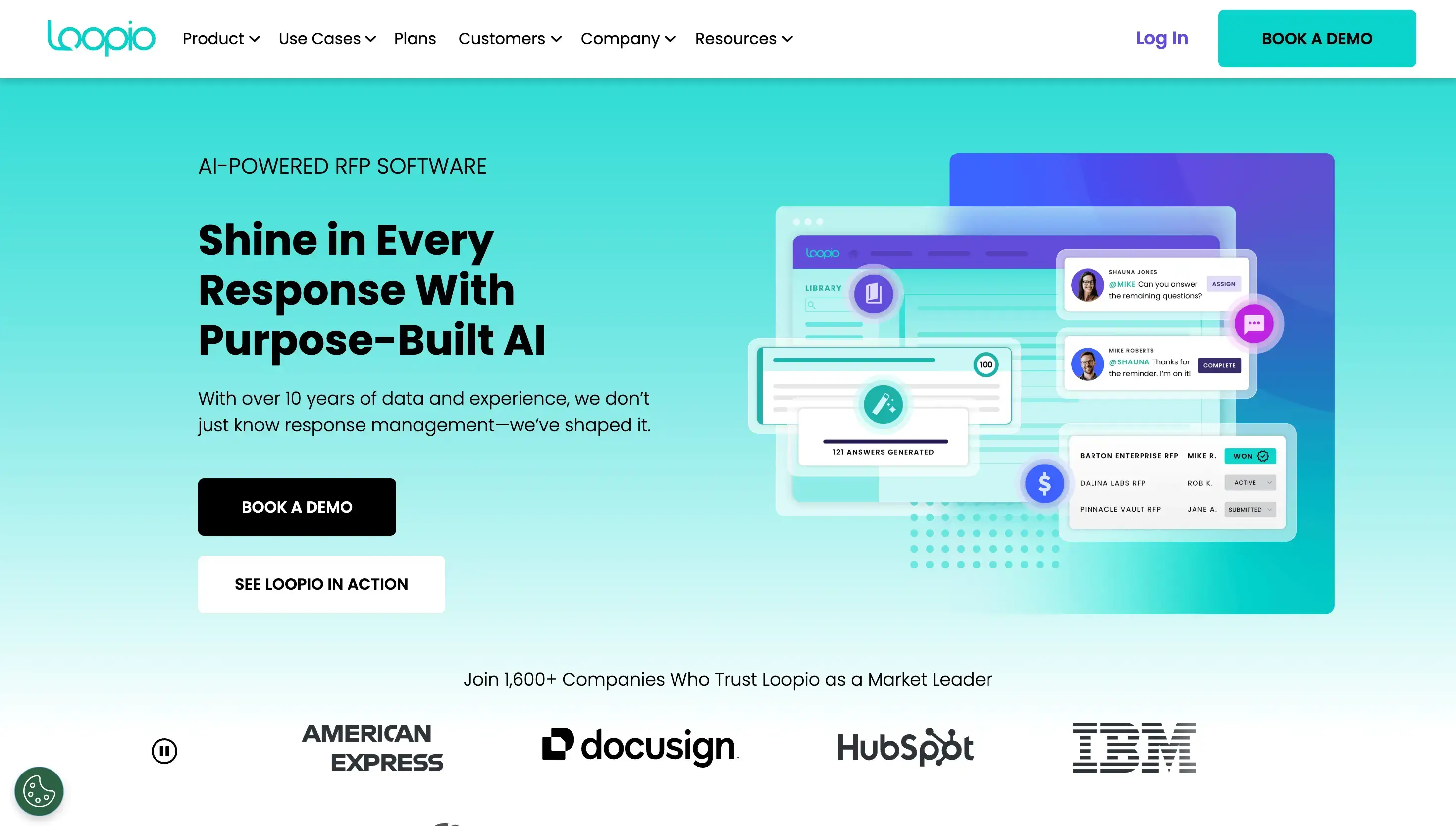
Loopio’s AI-driven content library is at the heart of its RFP automation process. This well-structured repository organizes and stores your team’s most valuable content, such as past RFP answers, case studies, and frequently asked questions, making it easy to access and reuse. Using AI to ensure the library remains accurate and up-to-date, Loopio streamlines locating the right content, enabling faster responses and significantly reducing search time.
This efficient content management not only speeds up your response workflow but also elevates the quality of your proposals by guaranteeing consistency and accuracy across all submissions.
Loopio’s intelligent features include its "Magic" smart suggestion tool, which leverages AI to analyze incoming RFP questions and automatically suggests relevant answers from your library. While user experiences may vary, this feature offers a significant advantage by providing a solid starting point for responses, particularly when tackling complex or repetitive queries.
This AI-powered approach ensures that your proposals remain rooted in your organization’s proven knowledge, reinforcing trust with evaluators and boosting your chances of securing bids.
In addition to crafting high-quality responses, Loopio equips teams with powerful analytics and reporting tools that deliver insights into their RFP processes. From proposal completion rates to response quality and team performance, these robust metrics offer valuable data for refining strategies and optimizing future proposals.
By leveraging these performance insights, teams can identify areas for improvement, make data-driven decisions, and ultimately amplify their win rates and business growth.
Qvidian (Upland Software) is one of the most established RFP and proposal management platforms in the market, trusted by over 200,000 users including eight of the ten largest US banks. It centres on a centralised content library where approved answers, case studies, and proposal sections are stored, searched, and reused. The AI Assist feature generates content, revises drafts, and personalises responses from that library.
It integrates natively with Salesforce, Microsoft Dynamics 365, and Microsoft 365, and supports multi-step review and approval workflows. Recognised as a G2 leader in both enterprise and mid-market segments.
Advantages: Deep content library with strong search and reuse; proven at enterprise scale; native CRM integrations; multi-step approval workflows; AI Assist for content generation and revision. Disadvantages: Less AI-native than newer platforms; best for organisations with substantial existing content libraries to leverage. Pricing on request.
XaitPorter transforms the bid and proposal process by combining automation and intelligent workflows that allow teams to collaborate in real-time, avoiding the constraints of traditional, linear file-based systems. With its ability to intelligently import RFP requirements, the platform instantly breaks down tasks and assigns responsibilities across the proposal team, ensuring that every task is accounted for. By leveraging powerful AI-driven recommendations through XaitAI, relevant content from the team's library is analyzed and suggested allowing stronger, more comprehensive responses to be crafted with significantly less effort and in record time.
Teams experience a dramatic acceleration in proposal submission, with turnaround times often reducing by up to 70%, enabling faster delivery and improved efficiency.
Consistency in branding and meeting compliance standards remains a critical priority, particularly for global enterprises and industries with strict regulations. XaitPorter’s AI-powered automation doesn’t just enhance speed; it enforces uniform formatting, language consistency, and branding adherence across all documents using customizable templates and automatic layout features.
Each proposal undergoes stringent checks against your company’s style guidelines and compliance criteria, reducing the risk of errors and optimizing the review cycle. Notably, XaitAI is a closed-system AI designed exclusively to work with internal company data, ensuring that your proprietary information remains secure and under full control, avoiding the vulnerabilities associated with public AI models.
XaitPorter enhances collaboration with secure functionality, allowing team members to co author proposals from any location. Changes and comments are revealed in real time, while progress is managed and tracked using an intuitive dashboard. With role-based access controls, specific tasks and permissions can be assigned to contributors, subject matter experts, and approvers ensuring clear accountability for responsibilities and deadlines.
The platform’s integrated version control and activity tracking keep teams aligned and mitigate risks of miscommunication, while cloud storage ensures the latest documents are accessible to distributed teams anytime, anywhere. This structured and dynamic environment not only boosts productivity but equips your team to deliver higher-quality, fully compliant proposals with greater confidence.
AI RFP software is transforming the future of proposal management by automating time-consuming tasks, enhancing accuracy, and improving team collaboration. Tools like Tenderbolt AI, Responsive.io, and Loopio equip your team to respond faster with higher-quality content, increasing win rates and securing a competitive edge.
By relying on centralized knowledge bases, real-time AI recommendations, and direct integration with your existing tech stack, the entire response process becomes more streamlined. To remain competitive leading into 2027, adopting these AI-powered solutions is not just advantageous but essential start leveraging automation today to boost productivity, achieve consistency, and increase proposal success.
AI RFP software is a cloud-based management system that uses artificial intelligence to streamline RFP processes. It supports sales, marketing, and compliance teams in automating RFP workflows, managing content, and improving efficiency throughout the proposal lifecycle.
AI enhances your business processes by automatically analyzing RFPs, suggesting relevant content, and learning from past submissions. This easy-to-use management software helps reduce manual work, accelerates response time, and improves overall ROI on proposal activities.
It’s widely used by sales teams, marketing automation specialists, proposal managers, and compliance officers in companies that deal with complex or high-volume RFPs. Teams using tools like Salesforce, HubSpot, or other SaaS and project management platforms benefit greatly from AI RFP integrations.
Top AI RFP tools (or "X products") typically include:
Main benefits include:
Yes, many AI RFP software providers offer a free trial so you can test features like automation, knowledge base setup, and CRM integrations before committing. It’s a great way to evaluate usability, team fit, and potential impact on your business processes.
Contact us now