.webp)
One private tender is much more than a simple quotation request. It represents a strategic opportunity for companies in all sectors, from construction and public works to consulting, including IT services. Unlike public contracts governed by strict rules, this selection procedure offers remarkable flexibility, but also requires a detailed understanding of its specific mechanisms in order to win the consultations.
At Tenderbolt, we work daily with sales and bid management teams to enable them to respond effectively to these private consultations. This article offers you a complete guide: definition, selection process, differences with public procurement, and proven strategies to increase your winning rate in 2026.
What is a private tender? Definition and characteristics
A private tender is a consultation launched by a company or a private organization to select a service provider capable of meeting a specific need. Unlike public procurement, this selection procedure is not subject to the demanding legal obligations of national advertising or transparency. The organization that launches the consultation has almost total freedom in defining its evaluation criteria.
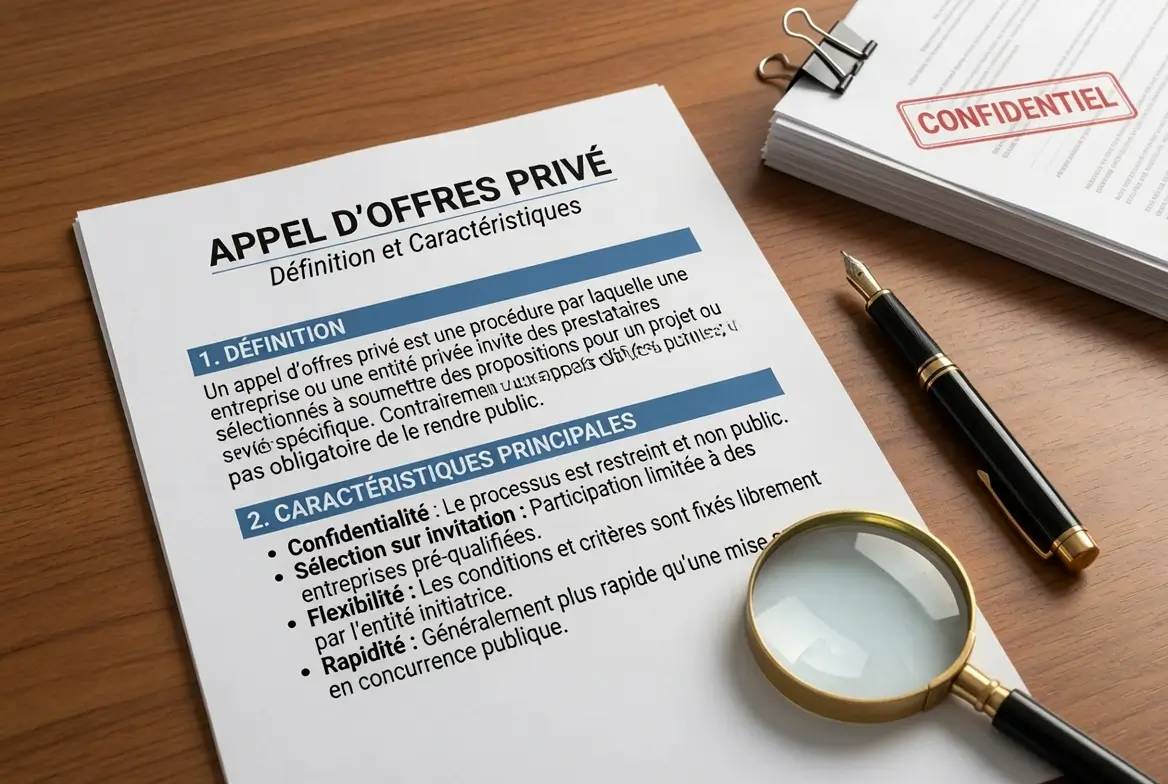
The main characteristics of this approach are:
- Discretionary launch with no obligation of official publication
- Evaluation criteria freely defined by the customer
- Flexible calendar, adapted to commercial emergencies
- Varied response file format (technical brief, specifications, commercial proposal)
- Number of candidates generally limited (3 to 5 providers on average)
This flexibility makes it a strategic acquisition channel. Businesses that master this type of procedure gain an average of 30 to 40% more consultations than those that rely solely on public calls.
The major differences between private tenders and public procurement
Understanding the differences between a private consultation and a public tender is crucial to adapt your response strategy. These two modalities obey diametrically opposed logics in terms of transparency, formalism and commercial tempo.
The table below summarizes the main differences:
This distinction is fundamental. This approach favors companies that cultivate privileged relationships with their customers and who know how to adapt their commercial message according to the buyer's profile. Conversely, a public tender rewards strict compliance with specifications and administrative completeness.
Process and key steps of a private consultation
The private consultation process follows a less rigid logic than that of public procurement, but it nevertheless involves predictable steps. Controlling this progression is essential to optimize your Tender response and your chances of winning.
- Identifying the opportunity: Detection by prospecting, networking or direct sourcing from the prospect
- Qualification of the need: Exchange with the customer to understand their real challenges beyond the formal specifications
- Official launch of the consultation: Sending the consultation file (RFP, specifications, specifications)
- Preparing the response: Establishment of the internal team, drafting of the technical brief and the commercial proposal
- Submission: Sending the offer before the deadline (generally respected to the nearest day)
- Customer review: Rating of the criteria defined at launch (quality, price, deadlines, references)
- Oral presentation or interview: Defense of the offer before the jury or key decision-makers
- Notification and signature: Announcement of the winner and signature of the contract
Each step is of strategic importance. A good qualification of the need beforehand can double your chances of winning this private AO. This is when you refine your positioning and anticipate the objections of your competitor.
Evaluation criteria specific to a private tender
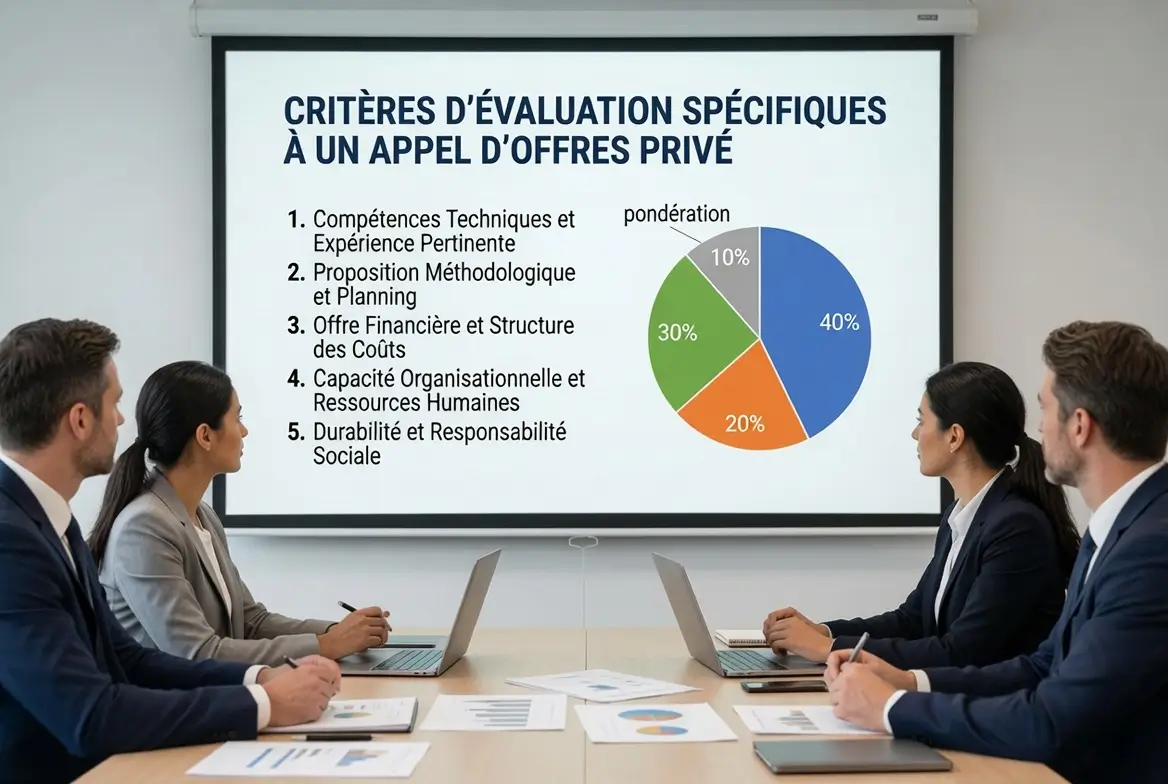
Unlike a public call for tenders where the criteria are published as soon as they are launched, private consultation gives the purchaser more leeway. However, certain criteria come up again and again and shape purchasing decisions.
The most common criteria are:
- Technical suitability: Capacity of the service provider to meet the specific requirements of the specifications
- Prices and commercial conditions: Competitiveness and price flexibility, payment deadlines
- Experience and references: Similar projects, sector customers, measurable success stories
- Quality of the team affected: CV and expertise of key resources
- Governance and reporting plan: Monitoring method, performance indicators, escalation
- Innovation and added value: Non-explicit aspects of the specifications, suggestions from the service provider
- Financial stability and solidity: Sustainability of the supplier, bank references
At Tenderbolt, we see that 70% of private consultations give equal weight to technique and price. The remaining 30% prefer either the established relationship or the proposed innovation. Adapt your Tender response depending on this relative weight is decisive for bid management.
Proven strategies for winning a private tender
Winning a private consultation requires a structured approach and flawless execution. Here are the tactics that work best with our customers.
First of all, invest in prior qualification. A phone call with the client project manager before the official submission allows you to clarify the unsaid, identify real priorities and adjust your positioning. This step increases your success rate by an average of 25 to 35%.
Second, focus on building a coherent commercial narrative. Your technical brief should not just list features; it should tell how you solve the customer's business problem. Structure your tender response around 3 to 4 key messages that dialogue with the explicit challenges of the specifications.
Thirdly, give priority to concrete and numerical use cases. Instead of saying “we deliver quality,” show how you increased the revenue of a similar customer by 15% in six months. Precise numbers carry three times as much weight as a simple statement.
Fourth, negotiate the conditions of a final interview if the procedure provides for it. This oral exchange is an opportunity to correct misunderstandings, to show the energy of your team and to widen a decisive distance from competitors. Check out our guide on Go no-go for the tender to refine your presentation strategy.
Fifth, use bid management tools so as not to forget anything. A centralized checklist, calendar follow-up of deadlines and a shared template binder increase your productivity by 40%. Tenderbolt precisely offers a dedicated platform to orchestrate this orchestration.
Role of AI in responding to private tenders
Artificial intelligence is radically transforming the way businesses prepare their responses to private consultations. In 2026, ignoring this revolution is like leaving money on the table.
The concrete use cases are multiple:
- Automated analysis of the specifications: Extraction of key criteria, identification of hard points and areas of opportunity
- Summary of similar consultations: Retrieving and aggregating winning patterns to adapt your template
- Generation of a first version of technical memory: Accelerating the writing process, freeing up the time of your business experts
- Compliance check: Verify that your tender response covers 100% of the points in the specifications
- Writing commercial elements: Structuring commercial arguments, optimizing the message
Businesses that incorporate AI into their private consultation process win 20% to 30% more consultations. They also gain in quality: a trained AI detects inconsistencies, oversights, and argumentative weaknesses that a tired human reader may miss.
At Tenderbolt, we built our SaaS platform around this principle: using AI not to replace your teams, but to amplify their expertise. Our engine analyzes incoming private tenders, offers draft responses, and centralizes all key elements in one place.

Pitfalls to avoid in a private tender
The difference between winning and losing deals is often in the details. Here are the most common mistakes and how to avoid them.
- Generic response not adapted to the customer: Send a turnkey template without customizing the message for the prospect. This is detected immediately and kills your market.
- Lack of direct response to the points in the notebook: Neglect to structure your technical thesis around the criteria listed in the specifications. The customer needs to find the answer to their question the first time.
- Pricing inconsistent with the scope: A price that is too low is surprising (poor perceived quality), a price that is too high without justification kills your chances. Analyze market prices before submitting your proposal.
- Lack of proof of capacity: Affirming without supporting. Each important statement must be accompanied by proof: customer, case study, certification.
- Late or incomplete submission: A second before the deadline is still a disqualification in 80% of cases. Deliver your offers at least 24 hours in advance.
- Lack of differentiation vs. competitors: Do not anticipate the three arguments of your rivals. This procedure is rarely won on price alone; it's the perceived value that counts.
Adhering to this avoidance list can double your success rate in one quarter.
Structuring your offer: technical brief, specifications and commercial proposal
The structure of your response depends on the format requested. Understanding the difference between a technical brief, a commercial proposal, and a specification is essential in order not to mix genres.
The Technical memory Explain the how: how you are going to execute the project, with what resources, what tools, what deadlines. It is a factual and structured document, divided into sections parallel to the points in the notebook. This document should show that you master the customer's business challenges.
La commercial proposal outlines the price, payment terms, deadlines, risks and insurances. It is often shorter than the technical brief, but it should show that you have encrypted accurately and that you are offering good value for money. A convincing commercial proposal anticipates price objections and proposes several scenarios (standard, premium, economic).
The specifications is generally written by the customer to describe their needs. You must respect it to the letter, but also complete it by offering points that are not covered. In your answer, you repeat its structure and you answer point by point.
A good response to this approach integrates these three elements in a coherent manner. The technical brief and the commercial proposal should tell the same story, with the same level of detail and ambition.
Tenderbolt: your ally in controlling private tenders
Managing these consultations effectively requires rigor, coordination and experience. This is exactly the challenge that Tenderbolt has been taking on for its customers for several years.
Our SaaS platform integrates all the tools necessary to orchestrate your private tender responses:
- Centralization of all your private consultations in one place
- Automated analysis of specifications with artificial intelligence
- Intelligent templates adapted to each sector (IT, construction, services, HR)
- Real-time collaboration between your technical and commercial teams
- Follow-up of the deadline calendar with automatic alerts
- Generating reports on your response rate, winning rate and average margins
We have supported more than 500 companies to increase their turnover resulting from these consultations. On average, our customers win 22% more consultations within three months of subscribing to Tenderbolt.
Ready to transform your bid management and increase your winning rates? See how Tenderbolt can help and contact us for a free demo. Our experts analyze your current process and offer you a tailor-made action plan.
Frequently asked questions
What is the difference between a private tender and a simple request for a quote?
Yes, there is a fundamental difference. A request for a quote is informal and one-sided: the customer sends a list of items or services, you respond with a price. A private tender is a structured procedure where the customer evaluates several criteria (technique, price, references, deadlines) and selects the best candidate among several service providers. This consultation is more engaging both parties and involves a formalized selection process. A request for a quote is often a more transactional purchase, while a private AO reflects a strategic issue or a contract of greater value.
How long does it take to write a response to a private tender?
It depends on the scope of the notebook and your preparation. On average, 3 to 4 weeks if you are starting from scratch. With templates, pre-written use cases, and a dedicated team, you halve this time frame. If you integrate a bid management platform like Tenderbolt, you earn an additional third. A simple consultation (15 pages) can be completed in 7 to 10 days if your team is well organized. A complex consultation (50 pages) can take 6 to 8 weeks if you start from scratch. Anticipating beforehand allows you not to stress about deadlines.
Is price the decisive criterion in a private tender?
No, not automatically. In 60% of cases, price is one criterion among others, but not the most important. Customers mainly assess the technical quality, the experience of the service provider and the compliance with the specifications. A 15% more expensive but technically better offer often wins this private AO. Conversely, a cheaper but vague or incomplete offer will be discarded. That's why you need to balance your proposal: competitive pricing + solid technical memory + proof of capacity.
How do I position myself in the face of private tenders in the public sector?
Public sector tenders are public tenders, subject to strict legal obligations. They differ radically from a private consultation. For public calls, strict compliance with the specifications, absolute transparency, defined response format. For a private tender launched by a local authority (purchase on behalf of a private company that it owns), the rules are similar to a private AO. Always check whether the procedure is subject to the Public Order Code (public) or not (private). Your response strategy will be radically different.
Do I have to respond to all the private tenders I receive?
No A response to this consultation costs internally (time, resources). It is better to select two or three with a high probability of winning than to answer ten with a low success rate. Use an eligibility criterion: scoring on an estimated budget, strategic fit, customer references, realistic deadlines. If the private tender does not match 70% of your strengths, decline. Focus your efforts on the real opportunities where you have a real chance of winning.
How do I prepare for a presentation interview for a private tender?
The interview is your chance to make a difference. Prepare a concise presentation (20 to 30 minutes maximum) that highlights the three key messages of your offer. Identify the key decision makers present and prepare responses to foreseeable objections. Provide concrete use cases with photos or videos. Ask questions to show that you understood the issues beyond the notebook. Finally, show the enthusiasm and serenity of your team: this approach is also a test of corporate culture and working relationships. A team that seems well-organized, responsive, and motivated is 30% more likely to win.
Private tenders represent a powerful and often under-exploited acquisition channel. By understanding the specific mechanisms and applying a rigorous methodology, you transform each opportunity into a won market. At Tenderbolt, we built our mission around this belief: well-used AI, coupled with good organization, increases your success rate by 20-30% in a few months. Ready to get started?