.webp)
You are responding to a public tender and you need to understand the role of forms DC1 DC2 ? These standardized administrative documents are the mandatory entry point for any application for French public contracts. Chez Tenderbolt, we support companies every day in the preparation of their files using artificial intelligence. This comprehensive guide dissects the structure, content, and mistakes to avoid on the DC1 (application letter and mandatary authorization) and the DC2 (statement of abilities), with practical tips for successful responses.
What are the DC1 and DC2 forms?
The DC1 and DC2 forms constitute the administrative basis for any application for a public contract. These documents, published by the Department of Legal Affairs (DAJ) of the Ministry of the Economy, harmonize the presentation of applications and facilitate their evaluation by tender committees. In 2026, their use remains essential for any company wishing to access public procurement.
Concretely, the DC1 formalizes the intention to apply and authorizes the mandatary of a group, while the DC2 justifies the candidate's abilities to execute the contract. Together, these two forms allow the public purchaser to verify the admissibility and legitimacy of each candidate before examining the technical and financial offer.
- DC1 : application letter formalizing the intention to participate and certifying the authorization of the group's representative
- DC2 : statement by the candidate detailing his technical and financial capabilities and his professional references
- Regulatory framework : governed by European Directive 2014/24/EU and the French Public Procurement Code
- Publication : official models distributed and updated by the DAJ, downloadable on the ministry's website
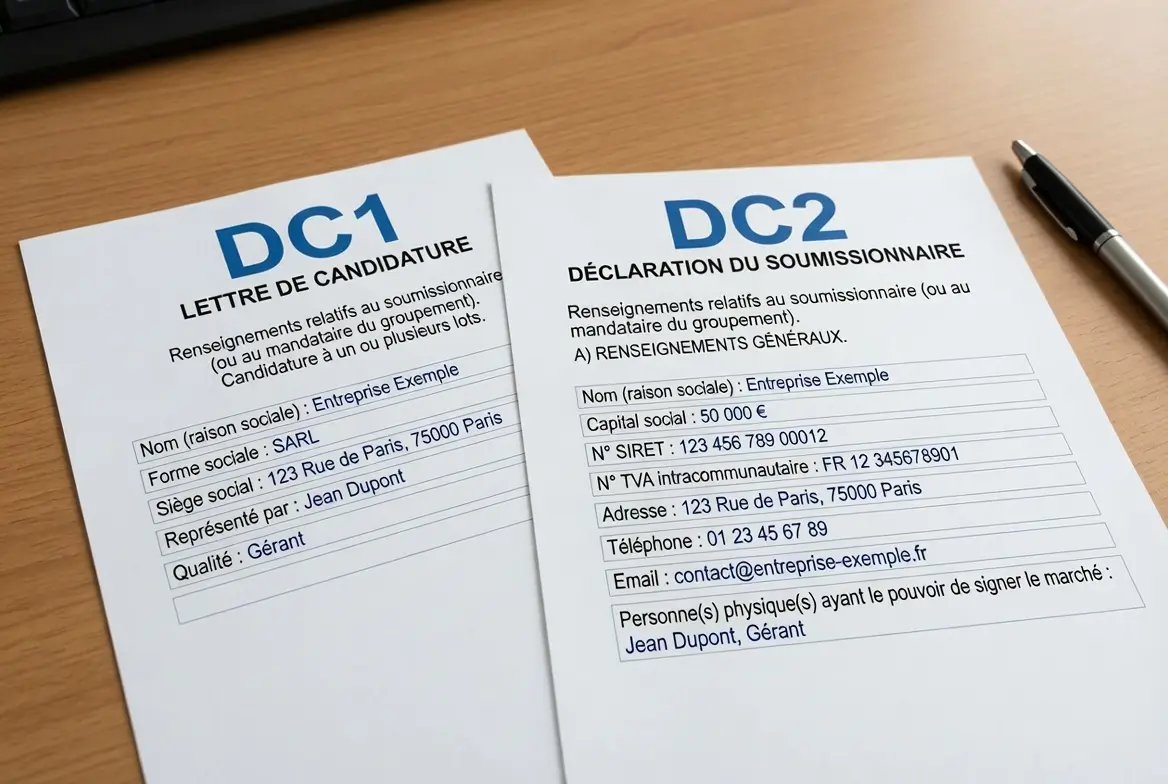
The DC1 form: application letter and authorization of the mandatary
The DC1 is your first contact with the tender committee. This form formalizes your desire to participate in the market and, in the case of a grouping, certifies that the mandatary is duly authorized by his co-contractors to represent them. An absent or invalid signature makes the file inadmissible, regardless of the quality of your offer.
For individual candidates, DC1 remains a mandatory formality even in the absence of grouping. It attests to your legal identity and your commitment to comply with the conditions of the tender. This is why vigilance is required from this first step: each field must be filled in exactly.
- Candidate identification : company name, head office, SIRET number and legal form
- Appointment of the mandatary : name of the official representative authorized to engage the group
- Authorization of co-contractors : each member of the group signs an act authorizing the mandatary
- Authorized signature : dated, legible, coming from a person with the legal power to sign (CEO, manager)
Note that the consistency between the information in DC1 and that of the DC2 is monitored by the committees. A different SIRET number between the two documents invalidates the entire file. The platform Tenderbolt guides you step by step to avoid these inconsistencies.
The DC2 form: statement of technical and financial capabilities and references
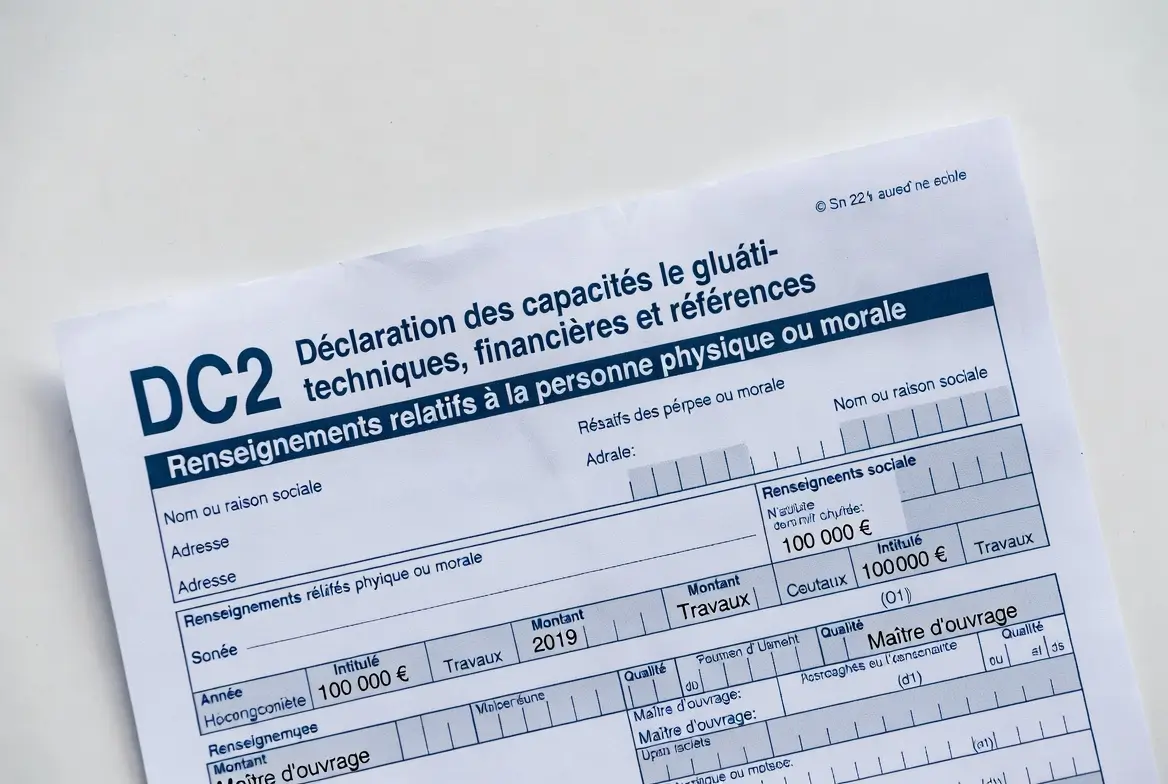
The DC2 is the key piece of your application file. This form justifies your ability to execute the contract by outlining your technical expertise, financial strength and professional references. Each individual candidate or each member of a group must complete a separate DC2.
While the DC1 opens the door, the DC2 keeps it open by proving your legitimacy. It is on this document that the assessment of your technical and financial eligibility is based. As a result, a botched or incomplete DC2 directly compromises your chances of qualifying, even if your offer is competitive.
- Technical capabilities : qualified workforce, equipment, ISO 9001 or ISO 14001 certifications, previous experience in similar markets
- Financial capabilities : balance sheets for the last two financial years, solvency ratios, professional insurance (liability, ten-year guarantee)
- Professional references : 3 to 5 recent and relevant contracts, with amounts, dates, sponsors and verification contacts
- Attachments : KBIS less than 3 months old, fiscal and social certificates, copies of certifications
The analysis of DCE (business consultation files) often reveals specific requirements that only a careful reading can identify. THETenderbolt DCE analysis AI automatically identifies these requirements for you.
Comparative table: DC1, DC2, DC2, DC3, DC4
The four DC forms form a coherent whole in the process of responding to public procurement. Understanding the role of each person allows you not to forget anything in your application and your offer. Here's how they differ:
What are the critical errors to avoid on DC1 DC2 forms?
The tender committees apply the admissibility criteria rigorously. A single administrative error can invalidate your application, regardless of the technical quality of your offer. According to data from the Business Ombudsman, around 30% of application rejections are linked to formal errors on the DC1 DC2 forms.
Indeed, the majority of these errors are avoidable with methodical proofreading. The most frequent pitfalls concern the signature, the completeness of the fields and the consistency between the documents in the file.
- Signature absent or invalid : makes the file inadmissible immediately, without the possibility of regularization in most cases
- Blank mandatory fields : results in an automatic administrative rejection by the commission
- Inconsistencies between DC1 and DC2 : a SIRET or a different name between the two documents invalidates the whole
- Outdated references : contracts that are more than 5 years old reduce your credibility with the buyer
- Missing supporting documents : Expired KBIS, expired insurance certificates or incomplete balance sheets
- Overdue delivery : one minute late is enough to definitively rule out your application
How to fill out your DC1 DC2 forms correctly: practical advice
The success of a public procurement application depends as much on preparation as on filling out. Before touching the DC1 DC2 forms, gather all of the required documents and verify their validity. This preliminary step saves you time and considerably reduces the risk of error.
In addition, each call for tenders includes specificities defined in the DCE. Always review this document before you start: some buyers require additional parts or specific formats. La dematerialization of public procurement now requires electronic filing on platforms such as PLACE, Atexo or Provigis.
- Step 1: gather the documents : KBIS of less than 3 months, certified balance sheets, insurance certificates, certifications, company statutes
- Step 2: Check consistency : accuracy of financial information, synchronization of SIRET and name on all documents
- Step 3: select references : choose 3 to 5 recent markets, relevant to the subject of the call for tenders in question
- Step 4: Cross-review : have the file reviewed by an external person to detect typos and inconsistencies
At Tenderbolt, we see on our projects that candidates who use a structured checklist before each submission reduce their form errors by 80%. Our AI platform automates this check.
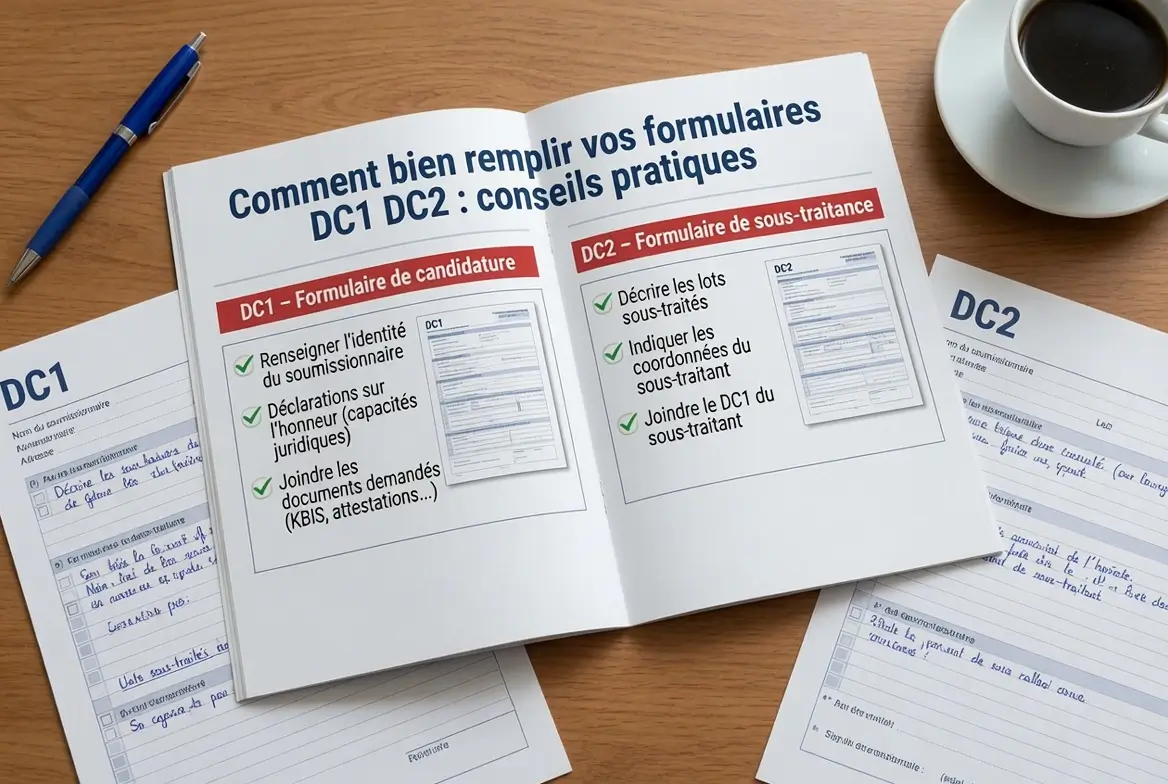
Complementarity with the DC3 and DC4 forms
The DC1 DC2 forms are just the first step in the process. After validation of your application, you will complete two additional documents: the DC3 (commitment act) and the DC4 (subcontracting declaration). These four forms form a coherent whole covering the entire procurement procedure.
In other words, the chronology is strict: the DC1 DC2 intervene during the application phase, while the DC3 and DC4 accompany the submission of the offer. Neglecting this sequence is tantamount to compromising your participation from the start.
- DC3: act of commitment : formalizes your final commitment to prices, deadlines and market conditions. Signed by the same authorized person as the DC1
- DC4: declaration of subcontracting : mandatory if you outsource a significant portion of the market. Identifies subcontractors and confirms their qualifications
- Responsibility : the agent company remains responsible for the entire market, including subcontracted services
FAQ: frequently asked questions about DC1 DC2 forms
Can I fill out DC1 DC2 forms by hand?
Yes, forms can be completed by hand or electronically. However, typing is strongly recommended to ensure optimal readability and to avoid rejections linked to illegible data. In case of handwritten filling, be sure to use black ink and write in capital letters. The signature, on the other hand, must always be handwritten, dated and come from a person authorized to engage the company.
What happens if my DC1 DC2 file is incomplete?
An incomplete application is generally rejected without examining the technical and financial offer. The public purchaser may, in some cases, grant a regularization period for missing documents, but this possibility depends on its internal policy and the consultation regulations. The best strategy remains to submit a complete file as soon as it is first submitted. Therefore, anticipate the collection of all supporting documents at least two weeks before the deadline.
Are the DC1 DC2 forms the same for all public purchasers?
The basic structures are harmonized by the DAJ of the Ministry of the Economy, which guarantees a common base for all French public contracts. On the other hand, each buyer can add specifications or request additional parts adapted to their market. Systematically consult the business consultation file (DCE) provided with the call for tenders to identify the expected particularities and adapt your file accordingly.
How do I justify my technical abilities in the DC2?
Provide concrete and verifiable references: previous contracts successfully executed, sectoral certifications (ISO 9001, ISO 14001, approvals), qualified personnel with diplomas and certifications, specialized equipment available. Each claim of capacity must be supported by an evidentiary document attached to the file. Give preference to recent references (less than 5 years old) and in direct relation to the subject of the target contract.
My business is new. Can I apply without long references?
Yes, a recent company can apply for public contracts. The absence of long references must be compensated by other proofs of capacity: diplomas and certifications from your team, strategic partnerships with experts in the sector, feasibility studies or pilot tests carried out, letters of recommendation from customers or partners. Be transparent about the youth of your company while promoting your real strengths and your technical added value.
How long does the DC2 data remain valid for?
Financial data (balance sheets, insurance certificates) must be less than 12 months old to be admissible. Professional references remain relevant if they concern contracts that are less than 5 years old. The KBIS must have been issued within 3 months prior to the submission of the file. Concretely, keep a standard application file updated at all times in order to be able to respond quickly to each new call for tenders.