RFP Automation with AI: What You Can Automate in 2026
What you can actually automate in the RFP process with AI in 2026: from intake and first draft to compliance checks. A practical guide for bid teams.
What you can actually automate in the RFP process with AI in 2026: from intake and first draft to compliance checks. A practical guide for bid teams.
AI-based RFP software in 2026 reliably automates the heavy lifting across the full response cycle: intake and qualification, first-draft generation, compliance checking, and submission. Bid teams that have adopted it report shorter cycles, higher win rates, and a system that keeps improving with every submission. This guide covers what AI can actually automate in the RFP process in 2026, where human judgment remains essential, and what it costs to stay manual.
For bid teams responding to RFPs, the pressure is straightforward: volumes are rising, buyers are raising their expectations, and the teams that respond manually fall further behind on every dimension. A procurement team that issues an RFP with 200 questions and a 30-day deadline expects a structured, compliant, detailed answer. Assembling that manually from scratch consumes weeks. The teams competing against you are not doing it manually anymore.
Artificial intelligence is transforming the way organizations respond to requests for proposals (RFPs). In 2026, AI-driven RFP software went from being an experimental prototype to mainstream tools that help teams quickly write responses, manage their knowledge bases, and assess supplier offerings.
AI RFP automation removes repetitive work, so humans can focus on strategy, positioning, and customer relationships.
This shift matters directly for suppliers. As buyers increasingly use AI to evaluate and score RFP responses, the gap between a well-structured, evidence-rich proposal and a generic one widens. Buyers can process more detail faster. That raises the bar for everyone responding. Understanding where AI is being deployed on the buy side helps bid teams anticipate what "good" looks like in 2026.
Generative AI has penetrated shopping very quickly. Even though many leaders use tools like ChatGPT for tasks such as emailing or proposal writing, most organizations have not yet industrialized these capabilities across their teams.
Despite this lag, a large majority of procurement managers (CPOs) around the world plan to deploy generative AI in some form or another in the next three years, especially for spend analysis and contract management.
Among the occasional uses, we find:
These targeted tasks show how AI increases human expertise by producing a first draft, by suggesting improvements, or by highlighting anomalies for humans to examine.
Semi-automated sourcing tools are already transforming informal stakeholder inputs into structured specifications. When offers arrive, the AI evaluates and scores each response, generates comparative summaries and can also suggest contractual language and SLAs.

Generative AI helps produce the initial answers to RFP questions by retrieving relevant information from the company's knowledge base and previous proposals. Instead of starting with a blank page, proposal teams receive pre-filled drafts with suggested paragraphs and recommended attachments.
As AI learns from validated responses, it reduces human error and ensures that responses respect the brand's tone and the organization's editorial guidelines. However, human reviewers remain essential to ensure accuracy, compliance, and strategic alignment prior to submission.
Predictive analytics can use historical RFP data, supplier performance indicators, and pricing models to objectively rank candidates. Scoring engines highlight high-potential suppliers based on past deliveries, financial stability, and compliance history, while also flagging risky responses for further review.
This level of automation accelerates evaluations and reinforces fairness by applying consistent scoring, based on clearly defined criteria, to all proposals.
Managing hundreds of attachments, drafts, and updates can slow down even the most well-organized teams. AI-powered document management systems automatically track versions, update references, and ensure that all collaborators are working on the latest content.
Integration with tools like Google Drive or SharePoint centralizes the knowledge library, avoids duplicates and allows real-time collaboration. These systems also apply access rights by role, guaranteeing data security while facilitating access.
AI improves communication with suppliers through centralized portals where suppliers can ask questions and receive contextual answers instantly. Chatbots connected to the knowledge base manage routine questions and only report complex topics back to experts.
During the negotiation phase, AI tools analyze market benchmarks and the results of past deals to recommend negotiation strategies, for example when to offer a dealership or maintain a position. Humans keep the final decision, but AI provides data-driven insights that shorten negotiation cycles and improve outcomes.
Once the supplier is selected, the AI helps to finalize the contract by:
It also automates deadline alerts, performs ongoing compliance checks, and feeds a dynamic contract management system that tracks performance and reports critical obligations.
Despite its advantages, AI-based RFP automation faces several challenges:
Excessive dependence on automation, without supervision, can lead to inaccuracies, biases, or the exclusion of innovative proposals that do not fit into traditional criteria.
That's why humans stay in the center of the loop.
Proposal managers and business experts still play a key role in:
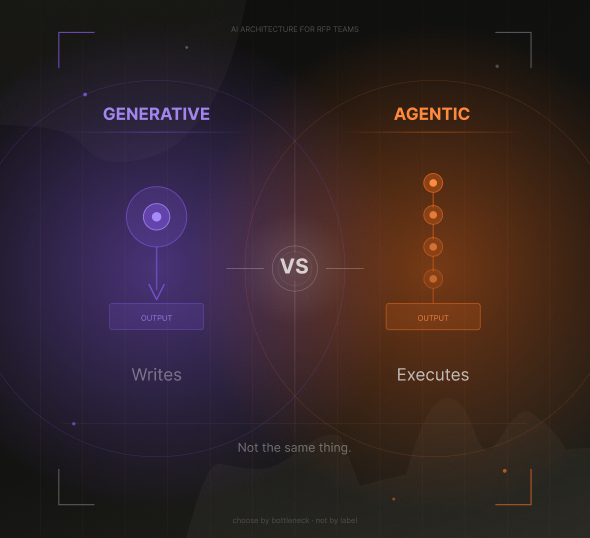
The most effective approach is a hybrid model where AI handles repetitive and analytical tasks, while humans keep control of judgment, differentiation, and compliance oversight.
Refusing to automate RFP work in 2026 isn't just a missed opportunity. This generates cumulative costs that affect revenue, risk exposure, and team performance.

The most visible impact concerns deadlines.
Manual processes for receiving, writing, and proofreading extend cycles and force teams to choose between speed and comprehensiveness.
Opportunities with tight deadlines are often abandoned or submitted in a weakened state, directly reducing short-term win rates.
In the long run, this creates a reputation for slowness, inconsistency, or frequent mistakes, which erodes the trust of buyers and internal stakeholders alike.
Buyers expect answers that are complete, accurate, properly formatted, and delivered quickly.
Manual processes struggle to meet these growing standards.
Without automation to impose templates, validate mandatory fields, and track attachments, last-minute errors occur precisely when the stress is at its peak and the mistakes are the most costly.
Content quality degrades when knowledge is scattered across file shares, mailboxes, and personal notes.
Teams are wasting time rewriting existing content, contradicting past commitments, or reusing outdated arguments.
Inconsistent messages about security, SLAs, or deployment create real contractual risks after signing.
The lack of a centralized and governed knowledge base means that newcomers take longer to develop skills, while experts become bottlenecks by answering the same questions over and over again.
A major invisible cost is the loss of a structured learning.
When the first drafts are written manually and the reviews are done by email, there is no clear feedback loop.
No visibility on:
The result: each new RFP starts almost from scratch, with no cumulative improvement over time.
Organizations that adopt automation are taking a head start.
They respond more quickly, improve quality week after week and increase load more effectively.
They go on the market with:
Most RFP automation content is written for buyers managing procurement. Tenderbolt was built for the other side of the table: the bid teams that respond.
It reads the full RFP or tender document, maps every requirement automatically, and drafts answers from your own validated content and past responses. Every answer links back to the source it came from. When the answer is not in your knowledge base, it says so rather than inventing one. No Shortcuts. No Hallucinations. No Excuses.
The automation Tenderbolt handles: document intake and requirement mapping, Go/No-Go scoring, first-draft generation from your knowledge base, security questionnaire completion, Excel grid filling, collaborative review and sign-off, and pre-submission compliance checks. The judgment it leaves to your team: strategy, differentiation, and the final call on every response.
Teams that use it report up to 70% time saved on response production, x4 velocity, and a 25% increase in success rate.
See how Tenderbolt automates your RFP responses
AI has already changed what "good" looks like in RFP responses. Buyers process more submissions faster and score them more consistently. Bid teams that still assemble every response manually are competing at a structural disadvantage, not just a speed disadvantage.
The teams that pull ahead in 2026 are not the ones that use AI for everything. They are the ones that use AI for the right things: intake, qualification, first drafts, compliance, questionnaire completion. Their experts spend their time on strategy, differentiation, and the proposals that matter most. That is the balance that drives shorter cycles, higher win rates, and a process that improves with every submission.
If you respond to RFPs and tenders regularly, that is exactly what Tenderbolt was built for.
AI can read the entire file, extract requirements, identify bottlenecks, and generate a qualification score which highlights the adequacy of the scope, risks and missing information.
It can also offer a Go or No Go recommendation with the evidence used, so that decision-makers can make a quick decision on a solid basis. This streamlines early cycle processes and helps teams better manage their workflow.
Modern systems integrate with your existing CRM or management tools to associate each question with your approved knowledge base. They detect duplicates, suggest contextually relevant responses, and adjust the tone and length to match the customer's model.
This simplifies the content management workflow and reduces errors associated with versioning or inconsistent metadata.
Yes. AI-driven management solutions maintain reference answers for common security topics (encryption, data retention, incident management, etc.).
These cloud systems fill out recurring forms, adapt the terminology to that of the buyer, and escalate exceptions to legal or IT security. They support process automation for faster and more compliant responses.
AI can analyze the structure of spreadsheets, understand mandatory fields, and validate entries using business rules. It fills in the appropriate cells, traces the origin of the data via metadata and reports uncertain values for human review.
For submission portals, it offers intuitive dashboards to manage and log entries field by field, guaranteeing traceability throughout the repository.
AI generates first full drafts by leveraging your approved content library, product documentation, and past submissions. It respects your brand tone, adds references, and adapts the structure according to RFP requirements.
These systems integrate with your project management platforms or CRM to produce deliverables. scalable and consistent.
Yes. The AI builds a retro-planning workflow based on the schedule imposed by the buyer, assigns managers, anticipates bottlenecks and gets team members back on track at the right time.
It also generates handoff documents for pricing, legal and delivery teams in order to ensure continuous improvement and avoid misalignments between teams. This replaces outdated management systems with more agile and automated planning.
The AI applies weights to qualitative responses, calculates scores based on constant criteria, and reports anomalies. The results feed into centralized dashboards, allowing purchasing or sales teams to easily visualize insights.
It supports the optimization of processes by reducing biases and subjective evaluation errors.
AI can suggest fallback clauses, preferred negotiating positions, and acceptable contractual formulations based on past results. It tracks changes, explains what has changed and why, and stores everything in a searchable repository.
This improves visibility, reduces legal risk, and supports compliant process automation.
Yes. Prior to submission, the AI verifies that all required sections are complete, that attachments are present, and that formatting rules are followed. It can block the submission until the necessary validations are obtained, ensuring strict control of the workflow and minimizing human errors in the final critical steps.
After submission, the AI aggregates cycle times, workloads, and reuse rates into visual dashboards. It analyzes win/defeat patterns and updates your content or strategy accordingly.
This supports continuous improvement and helps teams evolve their management and software environments around RFPs.
AI systems incorporate safeguards such as content approval workflows, version tracking, trust scores, and source traceability. Administrators can define roles, impose protocols in management tools and ensure that only approved content is used, especially on sensitive topics (pricing, SLAs, data management, etc.).
Structure your knowledge base by product, security, deployment, and commercial terms. Assign managers, set review frequencies, and replace vague text with modular content blocks.
A centralized, well-governed repository connected to your business workflows is the condition for making AI-based automation reliable and scalable.
AI is great at reading, synthesizing, and ensuring consistency. But human teams must continue to manage:
Think of AI as a engine for simplifying repetitive tasks, not as a replacement for expert judgment. In a mature management system, automation and human supervision work together.
Contact us now